Guide
Best Air Purifier for Mold (2026)
By Dr. Alex Chen · Updated 2026-03-10
By Dr. Alex Chen · Last updated March 10, 2026
The best air purifier for mold is the Alen BreatheSmart 75i, with True HEPA filtration and a customizable mold/bacteria filter covering up to ~580 sq ft at 4 ACH. It captures 99.97% of mold spores. For basements, pair a HEPA purifier with a dehumidifier — air purification alone cannot prevent mold growth.
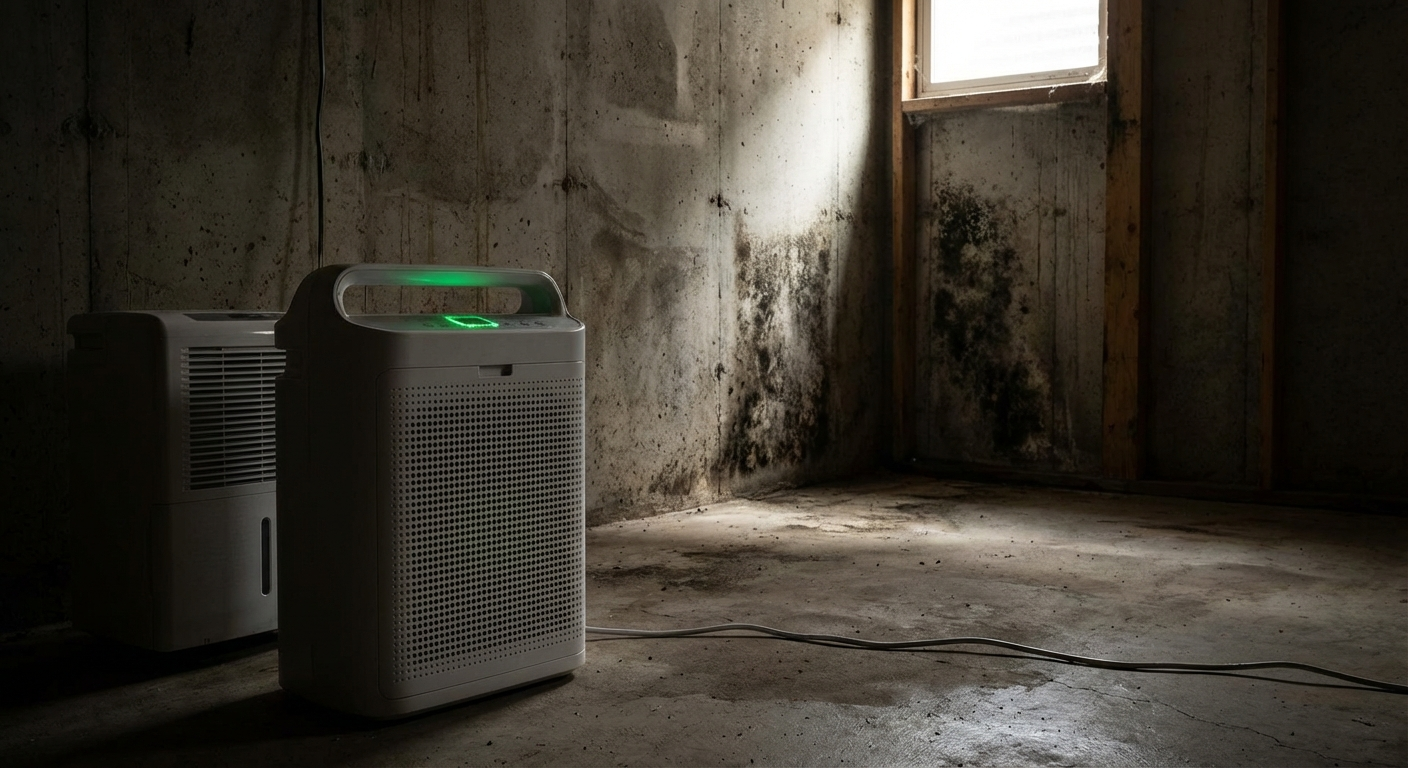
Mold is not just an aesthetic problem — it is a respiratory hazard. When mold colonies grow on damp surfaces, they release microscopic spores into the air. You inhale those spores with every breath, and for people with mold allergies, asthma, or compromised immune systems, the consequences range from chronic congestion and coughing to serious respiratory infections.
The CDC identifies indoor mold exposure as a cause of upper respiratory tract symptoms, cough, and wheezing in otherwise healthy people, and notes that it can trigger asthma attacks in mold-sensitized individuals. The EPA's guidance is clear: control moisture to prevent mold growth, and reduce exposure to airborne spores while you remediate.
A HEPA air purifier is one of the most effective tools for reducing airborne mold spore concentrations. But — and this is the point most guides skip — an air purifier does not solve a mold problem. It manages your exposure while you address the root cause: moisture. This guide covers both the best purifiers for mold spore capture and the essential humidity control context that makes those purifiers actually effective.
For asthma-specific air purifier recommendations where mold is a trigger, see our best air purifier for asthma guide.
Important: If you suspect significant mold contamination (visible growth larger than 10 square feet, or mold in HVAC systems), the EPA recommends professional remediation. An air purifier is not a substitute for mold removal. If you experience persistent respiratory symptoms, consult a healthcare provider.
Why Mold Is an Air Quality Problem
Mold is a living organism that reproduces by releasing spores — microscopic particles that travel through air, settle on surfaces, and germinate wherever moisture is available. A single mold colony can release millions of spores per day.
What Makes Mold Spores Dangerous
Allergens. Mold spores and fragments contain proteins that trigger allergic reactions in sensitized individuals. The Asthma and Allergy Foundation of America estimates that mold allergy affects approximately 1 in 5 people with allergies in the United States.
Mycotoxins. Some mold species — notably Stachybotrys chartarum (black mold) and certain Aspergillus species — produce toxic secondary metabolites called mycotoxins. These compounds can cause symptoms ranging from headaches and fatigue to more serious respiratory and neurological effects with prolonged exposure.
mVOCs. Active mold growth produces microbial volatile organic compounds — the gases responsible for the musty, earthy smell associated with moldy spaces. mVOCs can cause irritation of mucous membranes and headaches even in individuals without mold allergies.
Hyphal fragments. Beyond intact spores, mold produces tiny fragments of its branching structures (hyphae) that are small enough to penetrate deep into the lungs. These fragments are often smaller than intact spores and contribute to the overall allergenic and irritant load.
Where Mold Grows Indoors
Mold requires three things: moisture, an organic food source, and a surface temperature above approximately 40°F. Common indoor locations include:
- Basements — the most common mold location due to foundation moisture, condensation, and limited ventilation
- Bathrooms — shower steam, splashing, and inadequate exhaust fans create persistent dampness
- Kitchen areas — cooking steam, sink splashing, under-sink leaks
- Window frames — condensation from temperature differentials, especially in winter
- Behind walls — hidden plumbing leaks and condensation within wall cavities
- HVAC systems — condensation on cooling coils and in ductwork
What Air Purifiers Can and Cannot Do About Mold
This distinction is critical. Most guides gloss over it, and buyers end up expecting air purifiers to solve problems they physically cannot solve.
What Air Purifiers DO:
✅ Capture airborne mold spores — HEPA filters trap spores (1–20 microns) with effectively 100% efficiency as they pass through the filter
✅ Reduce your inhalation exposure — fewer airborne spores means fewer spores reaching your lungs
✅ Absorb musty mold odors — activated carbon filters absorb the mVOCs that cause musty smell (with limitations)
✅ Reduce spore settling on surfaces — by removing spores from the air, fewer settle on clean surfaces to potentially colonize
What Air Purifiers DO NOT:
❌ Kill mold growing on surfaces — the purifier cleans the air; it has no effect on mold colonies on walls, ceilings, or materials
❌ Remove moisture — mold needs moisture to grow; only a dehumidifier or ventilation improvement removes moisture
❌ Replace remediation — if mold is visible and growing, it must be physically removed; an air purifier manages exposure during and after remediation
❌ Prevent mold growth — as long as the moisture source exists, mold will continue growing and producing spores regardless of how many your purifier captures
The right mental model: An air purifier is your respirator — it protects your lungs from airborne spores. A dehumidifier is your prevention — it removes the moisture mold needs to grow. You need both in a mold-affected space.
How We Evaluate: HEPA, CADR, and Carbon for Mold
HEPA Filtration (Primary Criterion)
For mold spore capture, True HEPA or H13 HEPA filtration is the baseline requirement. Mold spores range from 1 to 20 microns — substantially larger than the 0.3-micron threshold that HEPA filters are tested against. This means any True HEPA filter captures mold spores with near-perfect efficiency.
"HEPA-type" filters should be avoided. Without a standardized performance threshold, they may allow smaller spore fragments and hyphal particles to pass through.
CADR and ACH (Performance Criterion)
A filter that captures spores perfectly is useless if the purifier does not move enough air through it. CADR (Clean Air Delivery Rate) and ACH (Air Changes per Hour) determine how quickly the purifier reduces spore concentrations in your room.
For mold spore reduction:
- 4 ACH minimum — baseline effectiveness
- 6+ ACH — recommended for rooms with active mold issues or for mold-allergic individuals
Activated Carbon (Odor Criterion)
HEPA filters do not capture gases. The musty smell of mold comes from mVOCs — gaseous compounds that pass straight through HEPA media. Activated carbon absorbs these gases, reducing the musty odor. The effectiveness depends on the carbon bed size:
- Thin carbon pre-filters (common in budget models): minimal mVOC absorption, needs frequent replacement
- Pelleted carbon beds (1+ lbs of granular carbon): meaningful mVOC absorption, longer effective life
- Specialized carbon blends (coconut shell carbon, potassium permanganate): target specific VOC compounds more effectively
Comparison Table: 5 Best Air Purifiers for Mold
| Air Purifier | Filter Type | CADR (Dust) | Noise (Low/High) | Coverage (4 ACH) | Activated Carbon | Antimicrobial Filter | Price | Best For |
|---|---|---|---|---|---|---|---|---|
| Alen BreatheSmart 75i | True HEPA | 347 CFM | 25–49 dB | ~580 sq ft | ✅ Yes (customizable) | ✅ Fresh filter option | ~$430 | Best overall for mold |
| Honeywell HPA300 | True HEPA | 300 CFM | 30–53 dB | ~500 sq ft | ✅ Yes (pre-filter) | ❌ No | ~$200 | Best budget high-CADR |
| Winix 5500-2 | True HEPA | 243 CFM | 27–56 dB | ~360 sq ft | ✅ Washable carbon | ❌ No | ~$170 | Best value mid-range |
| GermGuardian AC5900WCA | True HEPA + UV-C | 193 CFM | 28–50 dB | ~310 sq ft | ✅ Yes (charcoal) | ⚠️ UV-C (supplementary) | ~$170 | Best UV-C supplementary |
| Medify MA-40 | H13 HEPA | 330 CFM | 22–51 dB | ~550 sq ft | ✅ Yes (integrated) | ❌ No | ~$280 | Best for large basements |
Detailed Reviews
1. Alen BreatheSmart 75i — Best Overall for Mold
Why it wins for mold: The BreatheSmart 75i stands out for a feature no other purifier on this list offers: customizable filter panels designed for specific contaminant types. The Fresh filter option includes antimicrobial treatment that inhibits mold and bacteria growth on the filter media itself — addressing a real concern that captured mold spores could colonize the filter and continue producing spores inside the purifier.
At a dust CADR of 347 CFM, it is the second-highest-performing unit on this list, covering up to 580 sq ft at 4 ACH or approximately 390 sq ft at 6 ACH. The activated carbon layer in each filter option absorbs mVOCs that cause musty mold odor.
The 75i also offers a "forever guarantee" — a lifetime warranty that covers the unit itself (filters are consumable). For a mold problem that may require months of continuous operation, this warranty provides meaningful peace of mind.
Pros:
- Antimicrobial Fresh filter prevents mold growth on filter media — unique in this category
- Customizable filter panels (Fresh, HEPA-Pure, HEPA-Silver, HEPA-OdorCell) for different contaminant profiles
- High CADR (347 CFM) covers large rooms effectively
- Lifetime warranty on the unit
- Quiet operation (25 dB on low) — suitable for bedroom placement
- SmartSensor auto-mode adjusts to real-time particle levels
Cons:
- Premium price (~$430) — most expensive on this list
- Filter replacement cost is high (~$70–80 per filter, replaced every 9–12 months)
- No smart app — controls are on-unit only
- Large footprint (15" × 8.5" × 27") — not compact
- SmartSensor is basic compared to laser particle sensors
- Fresh filter's antimicrobial treatment does not eliminate the need to replace filters on schedule
Best for: Homeowners with significant mold concerns in large rooms — master bedrooms, living rooms, or basements up to 400 sq ft. The antimicrobial filter option is uniquely suited to environments where mold spores are continuously present. If budget is tight, the Honeywell HPA300 delivers comparable CADR at less than half the price.
2. Honeywell HPA300 — Best Budget High-CADR
Why it is strong for mold: The HPA300 is the workhorse of budget air purification — a no-frills True HEPA unit with a high dust CADR of 300 CFM. It delivers the raw spore-capture performance you need at a price that allows buying two units for the cost of one premium purifier — an effective strategy for covering both a bedroom and a basement simultaneously.
The HPA300 uses a carbon pre-filter for basic odor control, though its thin carbon layer is less effective at absorbing mVOCs than the dedicated carbon beds in the Alen or Winix. For pure spore capture volume, it is hard to beat at this price.
Pros:
- High CADR (300 CFM) at a budget price point (~$200)
- True HEPA — certified 99.97% at 0.3 microns
- Simple turbo mode for rapid spore reduction after disturbance (construction, cleaning)
- Widely available — replacement filters are easy to find
- 3 fan speeds plus turbo
- AHAM-verified CADR rating
Cons:
- Loud on high speed (63+ dB) — not suitable for bedroom use at turbo
- Carbon pre-filter is thin — limited mVOC/musty odor absorption
- No smart features, no auto-mode, no air quality sensor
- No antimicrobial filter treatment
- Higher energy consumption than competitors (~100W on high)
- Boxy industrial design — not aesthetically focused
Best for: Budget-conscious buyers who need maximum spore-capture CADR per dollar. Ideal as a second unit for a basement or utility room where noise and aesthetics matter less. Pair with a standalone carbon filter or odor absorber if musty smell is a concern.
3. Winix 5500-2 — Best Value Mid-Range
Why it works for mold: The Winix 5500-2 offers a compelling middle ground: True HEPA filtration, a washable activated carbon filter that reduces ongoing costs, and smart auto-mode — all at a lower price than the Alen. The washable carbon filter is a genuine cost advantage for mold situations where continuous odor absorption is needed, since you can rinse and reuse it rather than replacing it every few months.
The 5500-2 includes Winix's PlasmaWave ionizer. For mold-allergic individuals, this feature should be disabled. PlasmaWave produces trace ozone — levels that Winix certifies are safe (below CARB limits) — but any ozone production is a concern for respiratory-sensitive users. Disabling PlasmaWave does not affect HEPA performance.
Pros:
- Washable activated carbon filter — reduces long-term replacement costs
- True HEPA at a competitive price (~$170)
- Smart auto-mode with air quality sensor
- Sleep mode at 27 dB — quieter than most competitors at minimum
- Compact footprint for its coverage area
- AHAM-verified CADR
Cons:
- PlasmaWave ionizer produces trace ozone — disable for respiratory-sensitive users
- Coverage area (360 sq ft at ~4 ACH) is smaller than the Alen or Medify
- Dust CADR (243 CFM) is lower than the Honeywell or Medify
- Washable carbon filter effectiveness diminishes with repeated washing
- Plastic construction feels less durable than premium options
- No antimicrobial filter treatment
Best for: Mid-sized bedrooms and living rooms (up to 300 sq ft for adequate ACH). The best option if you want smart features and odor control without the Alen's premium price. Disable PlasmaWave and rely on the HEPA+carbon combination.
4. GermGuardian AC5900WCA — Best UV-C Supplementary
Why it is relevant for mold: The AC5900WCA combines True HEPA filtration with a UV-C light chamber that exposes captured particles — including mold spores — to germicidal ultraviolet light. The theory is that UV-C damages spore DNA, reducing the viability of captured spores on the filter.
In practice, the UV-C exposure time in portable air purifiers is very short (fractions of a second), and independent testing suggests the germicidal effect is limited compared to commercial UV-C systems. The HEPA filter is doing the actual work of capturing spores. The UV-C is a supplementary feature, not a primary defense.
The AC5900WCA also includes a charcoal pre-filter for basic odor absorption and a pet-focused filter option for homes where both mold and pet dander are concerns.
Pros:
- True HEPA + UV-C combination — supplementary germicidal treatment
- Budget-friendly at ~$170
- Charcoal pre-filter for basic musty odor reduction
- Compact tower design — fits easily in corners and small rooms
- Filter replacement indicator
- Pet dander filter option available
Cons:
- UV-C effectiveness against mold spores is limited in portable purifiers (short exposure time)
- UV-C bulb produces trace ozone — a concern for respiratory-sensitive users
- Lower CADR (193 CFM) than most competitors — smaller room coverage
- Charcoal filter is thin with limited mVOC capacity
- UV-C bulb requires separate replacement (~$15–20 annually)
- Tower design captures air from bottom only — less efficient air circulation than 360° intake
Best for: Small bedrooms and home offices (up to 250 sq ft) where you want an additional layer of germicidal treatment beyond HEPA filtration. Do not rely on UV-C as a primary mold defense — the HEPA filter is the core. Consider disabling UV-C if ozone sensitivity is a concern.
5. Medify MA-40 — Best for Large Basements
Why it is strong for mold: The MA-40 delivers one of the highest CADR ratings in its class (330 CFM dust) with H13 HEPA filtration — the European medical-grade standard. At 4 ACH, it covers approximately 550 sq ft, making it the best option for large basements, finished lower levels, and open-plan living areas where mold spore concentrations need to be managed across a significant volume.
The dual-intake design (air enters from both sides) increases effective filtration area and allows the MA-40 to maintain high CADR at relatively moderate noise levels. The integrated activated carbon layer absorbs mVOCs, though it is not as robust as the Alen's customizable carbon options.
Pros:
- High CADR (330 CFM) for large room coverage
- H13 HEPA — European medical-grade filtration standard
- Dual-intake design — efficient air circulation
- Moderate noise (46 dB on medium) for its output level
- Timer function (1, 2, 4, 8 hours) for targeted remediation sessions
- No ionizer — zero ozone production
Cons:
- No smart features — manual controls only, no auto-mode
- Carbon layer is integrated into the HEPA filter — cannot be replaced independently
- Filter replacement cost (~$50–60 per filter, every 3–6 months in high-mold environments)
- Higher filter turnover in moldy environments increases annual cost
- No antimicrobial filter treatment
- Build quality is functional but not premium
Best for: Large basements and open-plan ground floors where mold spore concentrations need to be managed across 400+ sq ft. The high CADR covers the air volume; pair with a dehumidifier to address the root moisture cause. For baby-safe purification in smaller rooms, see our best air purifier for baby room guide.
The Mold Science: Spore Sizes and Filter Mechanics
Understanding why HEPA is so effective against mold starts with spore sizes:
Common Indoor Mold Species and Spore Sizes
| Mold Species | Common Name | Spore Size | Where It Grows | Health Impact |
|---|---|---|---|---|
| Aspergillus | — | 2–5 µm | HVAC systems, damp walls, food | Allergic reactions; invasive infection in immunocompromised |
| Cladosporium | — | 3–10 µm | Window frames, bathroom tiles, textiles | Upper respiratory irritation, allergy |
| Penicillium | — | 2–5 µm | Wallpaper, carpet, insulation | Allergy; musty odor production |
| Stachybotrys | Black mold | 5–12 µm | Water-damaged drywall, cellulose materials | Mycotoxin production; severe respiratory symptoms |
| Alternaria | — | 7–20 µm | Showers, window condensation, damp walls | Strong allergen; asthma trigger |
The key insight: The smallest common mold spore (Aspergillus at 2 µm) is still nearly 7x larger than the 0.3-micron particle size that True HEPA filters are tested against. HEPA filtration is not just adequate for mold spores — it is massively over-specified. Any True HEPA or H13 HEPA filter captures mold spores with effectively 100% efficiency.
This means the differentiator between purifiers for mold is not filter quality (all True HEPA performs equally) but CADR, carbon filtration, and antimicrobial treatment:
- CADR determines how quickly spores are removed from the air
- Carbon filtration determines how effectively musty mVOC odors are absorbed
- Antimicrobial treatment determines whether captured spores can colonize the filter itself
Basement vs. Bathroom: Location-Specific Guidance
Basement Mold
The challenge: Basements have the largest air volumes, the highest moisture levels, and the least ventilation — the trifecta for mold growth. Spore concentrations in moldy basements can be orders of magnitude higher than in other rooms.
Purifier recommendation: Choose the highest CADR available — the Medify MA-40 (330 CFM) or Alen BreatheSmart 75i (347 CFM). Position the purifier in the center of the space, not against a wall, for maximum air circulation. Run continuously on medium-to-high speed.
Essential companion: A dehumidifier capable of maintaining relative humidity below 50%. The EPA recommends 30–50% relative humidity for mold prevention. In basements, a 50-pint or larger dehumidifier is typically necessary. Without humidity control, the mold source will out-produce your purifier indefinitely.
Floor considerations: Basements often have concrete floors that wick moisture. Elevate the purifier off the floor (on a shelf or table) to prevent moisture from affecting the filter media and electrical components.
Bathroom Mold
The challenge: Bathrooms are small but have extreme humidity spikes — a 10-minute shower can raise humidity above 80%. Mold grows on grout, caulking, ceiling corners, and behind tiles.
Purifier recommendation: A compact unit with adequate CADR for the small space — the GermGuardian AC5900WCA or Winix 5500-2. Bathroom air volumes are small (typically 200–400 cubic feet), so even moderate CADR achieves high ACH. Position the purifier away from direct water splash.
Essential companion: A functioning exhaust fan. Run the bathroom exhaust fan during and for 30 minutes after every shower. This removes moisture at the source — the single most effective mold prevention measure in bathrooms. If your exhaust fan is weak or absent, replace or install one before investing in an air purifier.
Electrical safety: Bathrooms and moisture create electrical hazards. Use a GFCI-protected outlet. Keep the purifier at least 3 feet from water sources. Never operate a purifier with wet hands.
Bedroom Mold
The challenge: You spend 7–8 hours breathing bedroom air while sleeping, making airborne spore concentration especially impactful here. Window condensation and closet dampness are the most common bedroom mold sources.
Purifier recommendation: Prioritize quiet operation over raw CADR — you need the purifier running all night. The Alen BreatheSmart 75i (25 dB on low) and Winix 5500-2 (27 dB on low) are bedroom-appropriate. Position the purifier within 6–10 feet of the bed for maximum protection during sleep.
Essential companion: Check window condensation regularly (wipe frames dry), ensure closets have air circulation (do not pack tightly), and monitor bedroom humidity with an inexpensive hygrometer.
The Humidity Factor: Why a Purifier Alone Is Not Enough
This is the most important section of this guide. An air purifier without humidity control is treating the symptom while ignoring the cause.
The Moisture-Mold-Spore Cycle
- Moisture accumulates on a surface (leak, condensation, high humidity)
- Mold colonizes the damp surface within 24–48 hours
- Spores are released continuously — millions per day from an established colony
- Your purifier captures spores from the air — reducing your exposure
- But the colony keeps producing — faster than any residential purifier can capture in a large space
Without addressing step 1, you are in an endless cycle. The purifier keeps your lungs safer, but the mold problem never resolves.
The EPA's Position
The EPA's "A Brief Guide to Mold, Moisture, and Your Home" states explicitly:
- Fix the moisture problem first. Clean up the mold. Then prevent moisture from re-accumulating.
- Indoor humidity should be maintained between 30% and 50%.
- Mold growth on surfaces larger than 10 square feet should be handled by a professional.
An air purifier is a legitimate component of this strategy — it protects your respiratory health during and after remediation. But it is one component, not the solution.
The Ideal Mold Management Setup
| Component | Role | Priority |
|---|---|---|
| Dehumidifier | Removes moisture; prevents new mold growth | #1 — address the cause |
| Remediation | Physically removes existing mold colonies | #2 — eliminate the source |
| Air purifier (HEPA) | Captures airborne spores; reduces inhalation exposure | #3 — protect your lungs |
| Ventilation | Exhaust fans, open windows — moves humid air out | #4 — ongoing prevention |
| Hygrometer | Monitors humidity to ensure it stays below 50% | #5 — verification |
Frequently Asked Questions
Can an air purifier kill mold?
An air purifier does not kill mold. HEPA filters capture airborne mold spores — trapping them in the filter media so you do not inhale them — but they do not kill mold growing on surfaces. Mold colonies on walls, ceilings, or damp materials will continue producing spores regardless of how many your purifier captures. You must address the moisture source and physically remove existing mold growth. An air purifier reduces your airborne exposure while you remediate, but it is not a substitute for remediation.
What size are mold spores and can HEPA filters capture them?
Mold spores range from 1 to 20 microns in diameter, with most common indoor species (Aspergillus, Cladosporium, Penicillium, Stachybotrys) falling between 2 and 10 microns. True HEPA filters capture 99.97% of particles at 0.3 microns — far smaller than any mold spore. This means HEPA filtration is effectively 100% efficient at capturing airborne mold spores that pass through the filter.
Should I use an air purifier in my basement for mold?
Yes, but only alongside humidity control. Basements are the most common location for mold growth due to higher moisture levels. An air purifier captures airborne spores, reducing your exposure when you enter the basement. However, without a dehumidifier keeping humidity below 50%, the mold source continues producing spores faster than any purifier can capture them. Use both: a dehumidifier to address the cause and an air purifier to reduce airborne exposure.
Do I need a special filter for mold or will regular HEPA work?
Standard True HEPA filtration is fully effective at capturing mold spores — no special mold-specific filter is needed for spore capture. However, some purifiers offer antimicrobial-treated filters (like the Alen BreatheSmart 75i Fresh filter) that inhibit mold growth on the filter media itself. This is a useful bonus but not essential. The more important addition is activated carbon filtration, which absorbs the musty mVOCs that mold produces.
Does humidity affect how well an air purifier works against mold?
Yes, significantly. High humidity (above 60%) creates conditions where mold grows faster, producing more spores than your purifier can remove. It also reduces HEPA filter lifespan — moisture can degrade filter media and promote mold growth on the filter itself. The EPA recommends maintaining indoor humidity between 30% and 50% for mold prevention. A dehumidifier paired with an air purifier is the most effective combination.
Can an air purifier remove the musty smell of mold?
Partially. The musty smell comes from microbial volatile organic compounds (mVOCs) — gases produced by active mold growth. HEPA filters do not capture gases. Activated carbon filters absorb mVOCs and can noticeably reduce musty odors. However, carbon filters have limited capacity and must be replaced regularly. If the musty smell persists despite a carbon-equipped purifier, active mold growth is still present and needs physical remediation.
Is UV-C effective against mold in air purifiers?
UV-C light can damage mold spore DNA, potentially reducing their viability. However, in portable air purifiers, the UV-C exposure time is extremely short — spores pass through the UV chamber in fractions of a second, which is often insufficient to kill them reliably. The HEPA filter does the heavy lifting by physically trapping spores regardless of whether they are alive or dead. UV-C is a supplementary feature, not a primary mold defense. Note that some UV-C systems produce trace ozone, which can irritate respiratory systems.
How many air changes per hour do I need for mold spore reduction?
For effective mold spore reduction, aim for at least 4 ACH in the affected room. For rooms with active mold problems or for individuals with mold allergies or asthma, 6+ ACH is recommended. Calculate ACH by dividing the purifier CADR (in CFM) multiplied by 60 by the room volume in cubic feet. A higher ACH means spores are captured faster after becoming airborne. For asthma-specific ACH guidance, see our best air purifier for asthma guide.
Sources & Methodology
This guide evaluates air purifiers for mold spore management using four primary criteria: HEPA filtration grade (True HEPA or H13 minimum), CADR and achievable ACH for effective spore removal, activated carbon capacity for mVOC odor absorption, and antimicrobial filter treatment to prevent spore colonization on the filter media.
Government and Medical References:
- EPA: A Brief Guide to Mold, Moisture, and Your Home — epa.gov/mold
- EPA: Mold Remediation in Schools and Commercial Buildings (guidance applicable to residential settings) — epa.gov
- CDC: Mold — Basic Facts — cdc.gov/mold
- CDC: Health Effects of Mold Exposure — cdc.gov
- Asthma and Allergy Foundation of America: Mold Allergy — aafa.org
Technical References:
- AHAM (Association of Home Appliance Manufacturers): CADR Verification Program — aham.org
- CARB (California Air Resources Board): Indoor Air Cleaning Devices — arb.ca.gov
- Mycological research on indoor mold species, spore sizes, and mycotoxin production
Methodology notes:
- CADR figures use dust CADR (1–5 microns) as the most directly relevant metric for mold spore capture, since mold spores fall within this range
- Room coverage calculations assume 8-foot ceiling height and are presented at both 4 ACH and 6 ACH thresholds
- Antimicrobial filter claims are sourced from manufacturer documentation; independent verification of antimicrobial effectiveness varies by product
- Noise levels in dB are manufacturer-rated at specified fan speeds
- Price and filter replacement costs reflect typical US retail pricing at time of publication
- We link to product search results to ensure links remain functional; we may earn a commission on purchases at no additional cost to you
- Affiliate relationships do not influence recommendations or rankings
- This guide is not medical advice; consult a healthcare provider for mold-related health concerns and a certified mold remediation professional for significant mold contamination
Internal links referenced: