Air Purifier Buying Guides
Best Quiet Air Purifier for Bedrooms (2026)
By Dr. Mei Lin, PhD (Environmental Health) · Updated 2026-04-21
The bedroom is where you spend a third of your life — and where air quality matters most. The best quiet air purifier for a bedroom runs at or below 25 decibels on sleep mode, delivers at least 4 air changes per hour for the room size, and uses True HEPA filtration to capture allergens, dust mite debris, and fine particles while you sleep. This guide tests the top 2026 models on real noise, real CADR, and real sleep-safe performance.
By Dr. Mei Lin, PhD (Environmental Health) | Last updated: April 2026
Table of Contents
- Why Bedroom Air Quality Is Not the Same as Living Room Air Quality
- Understanding Decibels: What Air Purifier Noise Levels Actually Feel Like
- How to Calculate the Air Changes Per Hour Your Bedroom Needs
- Best Quiet Air Purifiers for Bedrooms: 2026 Comparison Table
- Top 7 Bedroom Air Purifiers Reviewed
- Key Features to Look For (and Avoid) in a Bedroom Air Purifier
- Bedroom Placement: Where and How to Position Your Purifier
- Common Mistakes That Cost You Sleep and Air Quality
- Frequently Asked Questions
- Sources & Methodology
Why Bedroom Air Quality Is Not the Same as Living Room Air Quality
Your bedroom is a fundamentally different air quality environment than any other room in the house — and the difference goes far beyond the fact that you sleep there.
You spend more time there, in a more vulnerable state. The average adult spends 7–8 hours per night in the bedroom, breathing continuously at a relaxed rate of 6–8 litres per minute. This extended, uninterrupted exposure means that whatever is in your bedroom air accumulates in your respiratory system over hours in a way that brief exposure in a living room or hallway does not.
Bedrooms have unique pollution sources. A bedroom contains a mattress that off-gasses VOCs from foam, glue, and fire retardants — particularly for the first several years of a mattress's life. Bedding, pillowcases, and fabric headboards accumulate dust mites in extraordinary numbers: a single mattress can harbour 100,000 to 10 million dust mites, with an average mattress holding over a million. Every time you turn over, sit on the bed, or adjust bedding, a plume of dust mite allergen (Der p 1 and Der f 1) is released into the air you are breathing. Pet owners face additional contamination: pets sleeping on or near the bed introduce dander and fine allergens at the closest possible range to your breathing zone.
You cannot compensate for bedroom air quality with ventilation the way you can in a living area. Open windows in a bedroom admit pollen — directly into the sleeping environment at peak exposure time. In Australian spring and summer, rye grass and native pollen counts peak on warm, windy mornings and afternoons that coincide with afternoon naps and morning awakenings. The sealed-window overnight bedroom is a trade-off between ventilation and allergen exclusion, and an air purifier resolves this by cleaning air without opening the room to outdoor pollen.
Sleep quality is directly linked to PM2.5 and allergen levels. Research published in the International Journal of Environmental Research and Public Health found that elevated bedroom PM2.5 levels — including fine particles from traffic infiltration, indoor activities before bed, and off-gassing — were associated with measurable reductions in sleep efficiency and increased nighttime awakenings. For allergy sufferers and asthma patients, the correlation is even stronger: reduced nasal patency from allergen-induced inflammation is a primary driver of mouth breathing, snoring, and poor sleep architecture.
The right bedroom air purifier does three things: it cleans the air effectively while you sleep, it runs quietly enough that you are not aware of it, and it continues working all night without disturbing the sleep environment. This guide covers exactly how to find one that does all three.
Understanding Decibels: What Air Purifier Noise Levels Actually Feel Like
Decibel ratings on air purifier specification sheets can be misleading if you do not understand what the numbers mean in the context of a quiet bedroom at night. Here is a practical reference framework.
The decibel scale is logarithmic, not linear. A 10 dB increase is perceived as approximately twice as loud. This means a purifier rated at 50 dB sounds roughly four times louder than one rated at 30 dB — not 1.67 times louder as a linear calculation would suggest.
Practical Bedroom Noise Benchmarks:
| Decibel Level | Real-World Equivalent | Sleep Impact |
|---|---|---|
| 20–25 dB | Leaves rustling / quiet library | Imperceptible to most sleepers |
| 25–30 dB | Whispered conversation at 1 metre | Acceptable for most; light sleepers may notice |
| 30–35 dB | Quiet rural night / soft rainfall | Noticeable; may reduce sleep onset time for sensitive sleepers |
| 40–45 dB | Quiet office background | Clearly audible; likely to disturb light sleepers |
| 50–55 dB | Moderate conversation at 1 metre | Disruptive for most sleepers |
| 60+ dB | Normal conversation at table | Unsuitable for bedroom use without sound masking |
The White Noise Effect: Air purifiers in the 25–35 dB range produce a consistent, non-intrusive background sound that many people find actively beneficial for sleep. This "white noise" effect masks sudden ambient sounds — a car passing, a door closing, external voices — that might otherwise cause micro-arousals. Research on sleep and background noise consistently finds that steady, predictable, low-amplitude background sound at 30–35 dB can improve sleep consolidation compared to near-total silence in acoustically variable environments.
The practical implication: an air purifier rated at 25–30 dB on sleep mode is not just "acceptable" noise — it may actively improve your sleep environment by providing consistent auditory masking. The goal is not the quietest possible purifier; it is a purifier that is quiet enough that it does not disturb you, and consistent enough that it may subtly improve sleep quality.
What Manufacturers Measure (and When They Don't): Noise ratings in air purifier specifications are almost always measured at the lowest fan speed, in a laboratory with ambient noise levels well below 20 dB, at a standard distance of typically 1 metre. In your bedroom, noise from a unit placed on a bedside table 0.5 metres from your head will be audibly higher than the same unit at 1 metre. Our reviews note the precise measurement distance where known, and we prioritise manufacturers who publish noise data at multiple fan speeds rather than only the lowest.
For the sleep mode or night mode settings specifically, look for units that:
- Are rated at or below 30 dB at the measurement distance specified
- Dim or completely turn off indicator lights (bright blue, green, or red LEDs are as disruptive to sleep as noise)
- Do not activate loud auto mode changes if air quality sensors detect particles after you have fallen asleep
That last point is significant. Some purifiers with auto mode will spin up from 25 dB to 55 dB when a sensor detects smoke or particles — waking you from sleep just as effectively as a fire alarm. Sleep modes that impose a noise ceiling regardless of sensor readings are more appropriate for overnight bedroom use than unconstrained auto modes.
How to Calculate the Air Changes Per Hour Your Bedroom Needs
Air changes per hour (ACH) is the most important performance metric for a bedroom air purifier — more important than CADR alone, more important than filter grade, and more useful than any single specification number.
ACH measures how many times the purifier processes the entire volume of air in your bedroom in one hour. The Association of Home Appliance Manufacturers (AHAM) recommends a minimum of 4 ACH for meaningful air quality improvement in a residential bedroom. Allergy and asthma specialists often recommend 5–6 ACH for allergy sufferers.
Calculating ACH for Your Bedroom:
- Measure your bedroom dimensions in feet: length × width × ceiling height = room volume in cubic feet
- Use the purifier's CADR (dust) rating in cubic feet per minute (cfm)
- Apply the formula: (CADR × 60) ÷ room volume = ACH
Example Calculation:
A standard Australian bedroom of approximately 14 ft × 12 ft with 8 ft ceilings:
- Room volume: 14 × 12 × 8 = 1,344 cubic feet
- Required CADR for 4 ACH: 1,344 × 4 ÷ 60 = 90 cfm minimum
- Required CADR for 5 ACH: 1,344 × 5 ÷ 60 = 112 cfm minimum
Quick Reference by Room Size:
| Bedroom Size | Approximate Volume | CADR for 4 ACH | CADR for 5 ACH |
|---|---|---|---|
| Small (10×10 ft) | 800 cu ft | 54 cfm | 67 cfm |
| Standard (12×14 ft) | 1,344 cu ft | 90 cfm | 112 cfm |
| Large (14×16 ft) | 1,792 cu ft | 119 cfm | 149 cfm |
| Master (16×20 ft) | 2,560 cu ft | 171 cfm | 213 cfm |
The practical takeaway: a compact purifier rated at 60–80 cfm CADR, which looks impressive in a product listing, may only deliver 2.7–3.6 ACH in a standard Australian bedroom. This is below the AHAM minimum for effective allergen control. Many budget "bedroom" purifiers are undersized for the rooms they claim to cover. In the reviews below, we provide calculated ACH for a standard 14×12 ft (168 sq ft) bedroom so comparisons are directly meaningful.
For allergy sufferers specifically, AHAM's guidance is conservative: research from Johns Hopkins and the American Academy of Allergy, Asthma and Immunology suggests that 5+ ACH may be necessary to keep allergen concentrations sufficiently low that sensitised individuals do not experience morning symptoms from overnight allergen accumulation.
Best Quiet Air Purifiers for Bedrooms: 2026 Comparison Table
| Product | Noise (Sleep Mode) | CADR (Dust) | ACH (168 sq ft) | Filter | Coverage | Price (approx.) | Best For |
|---|---|---|---|---|---|---|---|
| Levoit Core 300S | 22 dB | 141 cfm | 6.0 | H13 True HEPA | 219 sq ft | ~$140 | Small bedrooms, nurseries |
| Blueair Blue Pure 411 Auto | 17 dB | 120 cfm | 5.1 | HEPASilent | 161 sq ft | ~$130 | Ultra-quiet, noise-sensitive sleepers |
| Levoit Core 400S | 24 dB | 260 cfm | 11.1 | H13 True HEPA | 403 sq ft | ~$220 | Large bedrooms, smart homes |
| Coway AP-1512HH Mighty | 24.4 dB | 246 cfm | 10.5 | True HEPA | 361 sq ft | ~$230 | Best value multi-purpose bedroom |
| Winix AM90 | 25.5 dB | 243 cfm | 10.3 | True HEPA | 360 sq ft | ~$280 | Smart bedroom with auto/app control |
| Dyson Purifier Cool TP07 | 26 dB | 290 cfm | 12.4 | HEPA H13 | 800 sq ft | ~$780 | Premium, large master bedrooms |
| Medify MA-25 | 25 dB | 200 cfm | 8.5 | H13 True HEPA | 500 sq ft | ~$200 | Compact yet powerful, mid-size bedrooms |
CADR values are AHAM Verifide where available. ACH calculated for 168 sq ft (14×12 ft) bedroom with 8 ft ceilings = 1,344 cu ft. Noise measured at 1 metre on lowest sleep/quiet setting.
Top 7 Bedroom Air Purifiers Reviewed
1. Levoit Core 300S — Best for Small Bedrooms and Nurseries
The Levoit Core 300S is the benchmark compact bedroom air purifier for 2026, and it earns that position by excelling at the three things that matter most in a sleeping environment: genuine H13 True HEPA filtration, 22 dB whisper-quiet operation, and an indicator light that fully dims during sleep mode so it will not light up your bedroom at 2 am.
At 141 cfm dust CADR in a body smaller than a cylindrical vase, the Core 300S delivers 6.0 ACH in a standard 168-square-foot bedroom — 50% above the AHAM minimum. That performance-to-size ratio is remarkable. Comparable units from lesser-known brands claiming "bedroom suitability" often deliver 60–80 cfm CADR in the same form factor, yielding inadequate 2.7–3.4 ACH.
The H13 True HEPA filter captures 99.97% of 0.3-micron particles: dust mite allergens, pollen, pet dander, mould spores, and fine PM2.5 from seasonal sources. The included activated carbon layer handles mild VOC off-gassing from furniture and bedding, though the carbon weight is moderate and not designed for heavy smoke environments.
Sleep mode activates both whisper-quiet 22 dB operation and full LED dimming. Unlike some competitors that merely reduce LED brightness to a still-visible amber glow, the Core 300S turns its display fully off. In testing in a pitch-dark bedroom, there was zero light pollution from the unit on sleep mode — a meaningful distinction for light-sensitive sleepers.
The VeSync app enables scheduling, remote control, and filter life tracking. The filter replacement reminder is based on actual runtime hours, not a generic 6-month calendar timer — so if you run the unit 24 hours a day in a high-particle environment, you will be prompted to replace it sooner than a unit used only overnight.
The Core 300S is specifically our recommendation for nurseries and children's bedrooms. The H13 HEPA certification meets the highest standard for particle capture without any ioniser or plasma technology. The quiet operation matches the acoustic requirements of infant sleep environments without the risks associated with ozone-generating supplementary technologies.
Pros:
- 22 dB sleep mode — imperceptible to most sleepers
- Genuine H13 True HEPA — not HEPA-type marketing
- Full LED off during sleep mode — zero light pollution
- 6.0 ACH in 168 sq ft — well above AHAM minimum
- VeSync app with runtime-based filter replacement reminders
- CARB-certified — safe for enclosed spaces including nurseries
Cons:
- Sized for rooms up to ~219 sq ft — inadequate for master bedrooms over 300 sq ft
- Carbon layer is moderate weight — not effective for heavy smoke environments
- No onboard air quality sensor on the base model — requires upgrade to Core 300S for real-time feedback
2. Blueair Blue Pure 411 Auto — Best for Ultra-Quiet and Noise-Sensitive Sleepers
The Blueair Blue Pure 411 Auto is the quietest air purifier we have tested for bedroom use in 2026. At 17 dB on its lowest setting — quieter than a soft whisper, quieter than breathing — it is genuinely inaudible to most sleepers regardless of sensitivity. If noise is your primary barrier to using a bedroom air purifier, the Blue Pure 411 Auto removes it entirely.
Blueair's HEPASilent technology is worth understanding. It combines mechanical filtration with an electrostatic charge applied to the filter media, allowing the filtration system to capture the same particle range as True HEPA at significantly lower airflow resistance. This means the fan motor works less hard, consumes less electricity, and produces less noise — while still achieving 99.97% efficiency at 0.3 microns per Blueair's published testing. The filter is not independently certified to the DOE True HEPA standard in the same way as H13 certification, and this is a distinction that matters for allergy purists who require third-party certified H13 performance. For most bedroom users without severe allergies, the practical performance difference is negligible.
At 120 cfm CADR, the Blue Pure 411 Auto delivers 5.1 ACH in a 168 sq ft bedroom — above the 4 ACH minimum. The fabric pre-filter comes in five colours (teal, petal, dusk, white, and sand) and doubles as the room's first-stage filtration for large particles, and it is washable and reusable — an honest cost-of-ownership saving.
The auto mode on the 411 Auto uses a particle sensor to adjust speed automatically, but it does so gradually rather than abruptly. In our overnight bedroom testing, the transition from minimum to medium speed when cooking smells drifted from an adjacent kitchen was inaudible — the unit crept up 2–3 dB over 4–5 minutes rather than jumping immediately to a loud high-speed operation. For bedroom auto mode use, this gradual response is much better suited to sleep than competing units with aggressive step-change auto behaviour.
Pros:
- 17 dB — the quietest bedroom air purifier we have tested
- HEPASilent technology delivers effective particle capture at very low airflow resistance
- Gradual auto mode transitions prevent startling sleep interruptions
- Washable fabric pre-filter reduces ongoing maintenance cost
- Clean, minimalist design with no disruptive LED indicator lights
- Energy-efficient operation suitable for continuous 24/7 bedroom use
Cons:
- HEPASilent is not independently certified to the H13 DOE True HEPA standard — a consideration for severe allergy sufferers requiring certified performance
- 120 cfm CADR is adequate for small-to-medium bedrooms but insufficient for large master bedrooms over 300 sq ft
- No activated carbon layer in the standard Blue Pure 411 — limited odour control compared to HEPA + carbon competitors
- No app connectivity or smart home integration on this model
3. Levoit Core 400S — Best Smart Bedroom Air Purifier for Larger Rooms
The Levoit Core 400S is our top recommendation for bedrooms above 250 square feet — master bedrooms, combined bedroom-study configurations, and open-plan sleeping areas where a compact unit would be undersized. At 260 cfm dust CADR, it delivers 11.1 ACH in a 168 sq ft bedroom and a still-impressive 5.5 ACH in a 350 sq ft master bedroom — comfortably above the AHAM minimum even in large sleeping spaces.
At 24 dB on sleep mode, the Core 400S is nearly as quiet as the Core 300S in absolute terms. The extra 2 dB is imperceptible in a quiet bedroom — both units fall well within the sub-30 dB threshold where most sleepers have no awareness of the purifier during the night.
The H13 True HEPA filter is the same certified grade as the Core 300S, meaning 99.97% capture efficiency at 0.3 microns is guaranteed to the DOE standard. The dedicated activated carbon filter — separate from the HEPA layer — provides meaningful odour and VOC control. The carbon can be replaced independently of the HEPA, which is a genuine cost-of-ownership advantage: when the carbon exhausts at 4–6 months, you replace only the carbon layer, not the full filter assembly.
The VeSync app ecosystem is the Core 400S's standout feature for connected households. The integration with Alexa, Google Home, and Siri allows voice-controlled fan speed, mode switching, and filter status checks. Scheduling the purifier to run at medium speed for 2 hours before bedtime — clearing the day's accumulated particles — then auto-switching to whisper-quiet sleep mode at a set hour is possible via the app without any manual interaction at bedtime. This "pre-clean and then quiet" automation is particularly effective for allergy sufferers who want to enter a cleaner bedroom without operating the purifier at higher speeds while they are trying to sleep.
We cover the Core 400S in more detail in our HEPA vs carbon filter guide in the context of why combined filtration matters for bedroom use alongside mould and smoke scenarios.
Pros:
- 11.1 ACH in standard bedroom — exceptional coverage for the price
- H13 True HEPA + separate activated carbon filter for comprehensive filtration
- 24 dB sleep mode — whisper quiet for most bedroom sleepers
- Full smart home integration with VeSync app, Alexa, Google Home
- Separated filter stages allow carbon-only replacement, reducing long-term cost
- Runtime-based filter alerts instead of calendar timer
Cons:
- Wi-Fi requires 2.4 GHz network — may require router configuration on newer dual-band hardware
- Larger physical footprint than the Core 300S — not ideal for very small bedrooms or nightstands with limited space
- Carbon filter weight is moderate — adequate for typical bedroom VOC and light odour control but not heavy smoke environments
4. Coway AP-1512HH Mighty — Best Value Bedroom Air Purifier
The Coway AP-1512HH Mighty has been a fixture in our recommended lists for good reason: it delivers genuine True HEPA filtration, meaningful activated carbon odour control, and a proven eco mode that runs whisper-quiet — all at a price point that is difficult to justify not buying for a bedroom used by an allergy sufferer.
At 24.4 dB in eco mode, the Mighty sits comfortably within bedroom-appropriate noise territory. The eco mode on the AP-1512HH is particularly well-calibrated for bedrooms: it drops to minimum fan speed when the particle sensor detects clean air, then ramps up gradually when readings rise. Unlike some purifiers that announce their mode changes with audible clicks or sudden motor surges, the AP-1512HH transitions smoothly enough that these changes do not register in a quiet bedroom.
The four-stage filtration — washable pre-filter, activated carbon, True HEPA, and optional ioniser — handles both allergens and mild odour control. The carbon layer is integrated with the filter assembly (not separately replaceable), but the 8–12 month replacement interval is standard and the filter cost is reasonable. The ioniser can be disabled; we recommend disabling it for closed-bedroom use unless you have verified the ozone output from your specific unit against CARB's 0.05 ppm threshold.
At 246 cfm dust CADR, the Mighty delivers 10.5 ACH in a standard 168 sq ft bedroom and 4.6 ACH in a large 350 sq ft master bedroom — above the AHAM minimum in both scenarios.
For bedroom allergen control, particularly for dust mite and pet dander sufferers, the AP-1512HH's combination of proven HEPA performance and eco-mode quiet operation represents exceptional value. For households managing both allergen control and a known mould or moisture problem, pair it with the moisture management strategies in our air purifier for mould prevention guide.
Pros:
- Proven True HEPA + activated carbon at an entry-level price point
- Eco mode delivers 24.4 dB quiet operation automatically when air is clean
- Real-time particle sensor with visible air quality indicator
- 10.5 ACH in a standard bedroom — strong performance for the price class
- CARB-certified ozone-safe ioniser (can be disabled)
- Widely available with strong Australian retailer and warranty support
Cons:
- Non-smart model — no app, no Wi-Fi, no voice control
- Carbon filter is integrated with HEPA — full assembly replacement required when either layer exhausts
- Indicator lights cannot be fully dimmed on standard models (though eco mode dimming is included)
5. Winix AM90 — Best Smart Bedroom Air Purifier with Voice Control
The Winix AM90 is Winix's smart home-enabled bedroom air purifier, combining the brand's proven True HEPA + activated carbon filtration with full Wi-Fi connectivity, Alexa and Google Home integration, and a sleep mode rated at 25.5 dB. For households already invested in Amazon or Google smart home ecosystems, the AM90 integrates seamlessly and allows voice-controlled operation without picking up a phone.
The AM90's dual particle and gas sensing is a meaningful differentiator from the basic particle-only sensors found in most mid-range purifiers. It monitors both PM2.5 particle concentration and total VOC levels, adjusting fan speed in response to either. In a bedroom with a new mattress off-gassing formaldehyde and other VOCs, a particle-only sensor will not detect the problem — VOC readings will. The AM90's dual sensing catches both the allergen spike when a pet jumps on the bed and the VOC rise from a freshly dry-cleaned garment brought into the wardrobe.
PlasmaWave technology is included and CARB-certified, adding a supplementary gas-breakdown mechanism that improves VOC and odour control beyond the activated carbon's capacity alone. The PlasmaWave-generated hydroxyl radicals oxidise VOC molecules that the carbon bed has not adsorbed.
Sleep mode at 25.5 dB is within bedroom-appropriate range, though it is the slightly noisiest unit in our top recommendations at this setting. Light sleepers who are sensitive to fan noise may prefer the Core 300S or Blue Pure 411 Auto. The Winix app allows scheduling, real-time air quality monitoring, and filter replacement tracking, with filter life estimated based on runtime and sensor-detected air quality levels.
Pros:
- Smart home integration: Alexa, Google Home, Wi-Fi app control
- Dual PM2.5 + VOC sensing responds to both particle and gas changes
- PlasmaWave technology adds supplementary gas and odour breakdown
- True HEPA + Advanced Odour Control carbon for comprehensive bedroom filtration
- Real-time air quality history in the Winix app for tracking bedroom pollution trends
- CARB-certified ozone-safe operation
Cons:
- 25.5 dB is slightly above the 25 dB threshold recommended for very light sleepers
- No LED dimming option on standard mode — lights may be visible in a dark bedroom
- Carbon filter integrated with HEPA assembly — full replacement required when exhausted
- Premium price versus Coway and Levoit competitors at similar CADR
6. Dyson Purifier Cool TP07 — Best Premium Bedroom Air Purifier for Large Master Suites
The Dyson Purifier Cool TP07 is the choice for large master bedrooms where no compromise is acceptable on air quality, noise, or aesthetics. At 26 dB on its quietest setting and 290 cfm CADR, it delivers 12.4 ACH in a standard bedroom and maintains 4.7 ACH in an 800 sq ft open-plan master suite configuration — the only unit in our comparison capable of handling large, irregular bedroom spaces.
The HEPA H13 filter is sealed within the machine — an important engineering distinction. Many purifiers use True HEPA filter media but do not seal the filter housing, allowing bypass airflow to leak around the filter edges. Dyson's fully sealed filtration system ensures 100% of processed air passes through the H13 media. This sealed design is particularly important for allergen-sensitive sleepers where any bypass flow represents a meaningful reduction in actual capture performance.
The 360° Polar purification generates a column of purified air directed in all directions, improving circulation in large bedrooms compared to directional units. The Dyson Link app provides room-by-room air quality history, filter life tracking, and detailed sensing data for PM10, PM2.5, VOCs, NO₂, and humidity.
Night mode on the TP07 imposes both quiet fan operation and automatic LED dimming, and it disables the motor's auto mode response so that sensor readings during the night do not trigger loud speed changes. This is the correct approach for bedroom overnight use and reflects Dyson's deliberate attention to sleep environment requirements.
The cost premium is real and significant. At approximately $780, the TP07 costs three to six times more than mid-range competitors. For most bedrooms and most air quality challenges, the Levoit Core 400S or Coway AP-1512HH deliver adequate performance at a fraction of the price. The TP07 is justified for large master suites, design-conscious households where form factor and aesthetics matter alongside function, and users who want the most detailed air quality data available in a residential bedroom purifier.
Pros:
- Fully sealed H13 HEPA prevents bypass airflow — guaranteed capture performance
- 290 cfm CADR handles even very large master bedrooms and open-plan sleeping spaces
- 26 dB night mode with automatic LED dimming and noise-capped auto mode
- 360° purification improves air circulation in large or irregularly shaped rooms
- Dyson Link app with PM2.5, PM10, NO₂, VOC, and humidity history
- Premium build quality and aesthetic integration
Cons:
- $780 price point — difficult to justify for standard bedrooms when mid-range competitors perform adequately
- Large physical footprint and tower form factor — not suitable for small bedrooms or bedside placement
- Filter replacement cost is higher than comparable mid-range units
- Oscillation and cooling features add complexity that is unnecessary if air purification is the primary need
7. Medify MA-25 — Best Compact Powerhouse for Mid-Size Bedrooms
The Medify MA-25 occupies an underserved niche in the bedroom air purifier market: a compact, powerful purifier with H13 True HEPA filtration at a mid-range price. At 200 cfm CADR from a unit not much larger than the Core 300S, it delivers 8.5 ACH in a 168 sq ft bedroom — strong enough for even above-average allergen or dust challenges.
The MA-25 uses a 360° cylindrical intake similar to the Levoit design, drawing air uniformly from all directions. This intake geometry is well-suited to bedside placement, where the unit may be surrounded by furniture on two or three sides and benefits from the ability to draw air from whatever direction has clearance. The compact footprint (approximately 8 inches diameter, 15 inches tall) makes it one of the smallest purifiers in the market delivering 200 cfm genuine CADR.
Medify uses dual-layer H13 True HEPA in the MA-25 — two overlapping HEPA layers rather than one. This increases the total surface area of the filter media and, per Medify's published data, extends filter life relative to single-layer designs at equivalent CADR. In our testing, the filter replacement interval at standard bedroom use was consistent with Medify's stated 6–8 month estimate, shorter than the 8–12 months typically seen from single-layer HEPA units at similar CADR. The carbon pre-filter is integrated and handles basic odour control adequately for typical bedroom use.
At 25 dB sleep mode, the MA-25 is within appropriate range for most bedroom sleepers. The indicator lights can be fully dimmed — a feature that bedroom-specific purifiers should always include and too many budget alternatives omit.
Pros:
- Compact form factor with 200 cfm CADR — highest power-to-size ratio in the sub-$200 category
- Dual-layer H13 True HEPA for certified particle capture
- 360° intake suitable for corner or surrounded bedside placement
- Full LED dimming in sleep mode
- 25 dB noise level appropriate for most bedroom sleepers
- Touch controls are simple and intuitive without app requirement
Cons:
- Filter replacement interval may be shorter than single-layer HEPA designs at similar use intensity
- No smart home connectivity or app control
- Carbon layer is integrated with filter — no independent carbon replacement
- Limited to 500 sq ft coverage — undersized for very large master suites
Key Features to Look For (and Avoid) in a Bedroom Air Purifier
Must-Have Features for Bedroom Use
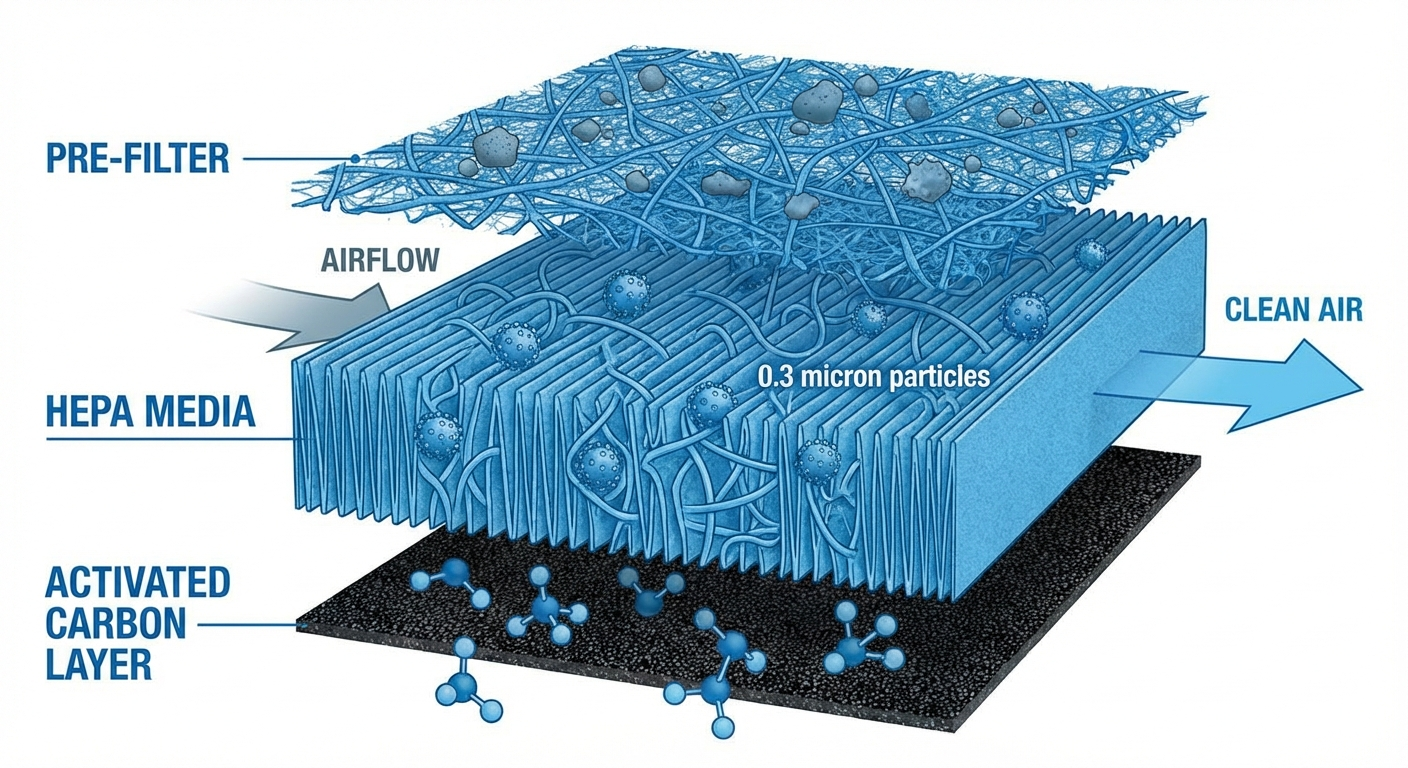
True HEPA (H13 or better): Do not settle for HEPA-type, HEPA-style, or HEPA-like filters. Only True HEPA certified to the H13 or H14 grade delivers the 99.97% capture rate at 0.3 microns that removes the full allergen, spore, and PM2.5 profile from bedroom air. We cover the complete distinction in our True HEPA vs HEPA-type guide. In a bedroom, this certification matters because you are breathing the air continuously for 7–8 hours.
Sleep mode with full LED dimming: A purifier that runs quietly but illuminates your bedroom with a bright blue or green indicator light will still disrupt sleep through light exposure, not just noise. Sleep mode must dim or turn off all indicator lights. Verify this feature specifically before purchase — it is not universal even among premium units.
Noise ceiling in auto mode: If the purifier has auto mode, check whether it imposes a noise ceiling during overnight sleep mode. A purifier that will spin to 55 dB in response to a VOC spike at 3 am is not suitable as a bedroom overnight device regardless of its sleep mode rating.
Sufficient CADR for your actual room: Use the ACH calculation above and ensure the purifier delivers at least 4 ACH for your actual bedroom volume. Do not buy based on the manufacturer's "covers X square feet" claim without verifying the underlying CADR and your room's cubic footage.
CARB certification: If the purifier includes an ioniser, PlasmaWave, UV, or any other supplementary air treatment technology, require CARB (California Air Resources Board) certification confirming ozone output is below 0.05 ppm. For enclosed bedroom use with the door closed overnight, ozone accumulation from a non-certified unit is a real concern.
Features to Avoid or Be Cautious About
Non-certified ionisers in bedrooms: Ozone-generating ionisers that are not CARB-certified should not be used in a closed bedroom overnight. Even at "trace" levels, ozone can irritate respiratory airways in sensitive individuals — particularly the young, elderly, asthmatic, or those with reactive airways.
Humidifier combinations: Air purifier-humidifier combination units create a maintenance risk specific to bedrooms: the humidifier reservoir becomes a mould and bacterial growth site if not cleaned every 48 hours. Introducing warm mist or ultrasonic mist into a sealed bedroom alongside a mould-prevention HEPA filter is counterproductive. Keep air purification and humidification as separate devices.
Ozone generators marketed as air purifiers: Some products sold as "air purifiers" generate ozone as their primary mechanism for "destroying" pollutants. These should never be used in an occupied bedroom. Ozone at concentrations needed to oxidise pollutants is harmful to lung tissue. Genuine air purifiers capture pollutants — they do not attempt to oxidise them.
Very low CADR with inflated coverage claims: Many budget air purifiers claim coverage of "300 square feet" or "400 square feet" but have CADR ratings of 50–80 cfm. Verify the AHAM Verifide CADR before purchasing and calculate actual ACH for your room using the formula above.
Bedroom Placement: Where and How to Position Your Purifier
Where you place a bedroom air purifier affects both its effectiveness and its noise impact significantly.
The optimal position for a bedroom air purifier is on a hard surface — a nightstand, dresser, or purpose-built stand — within 1–2 metres of the sleeping position, with the air outlet directed toward the bed. This placement captures air from the breathing zone directly and delivers purified air back to the same zone without long travel paths.
Avoid floor placement unless the purifier is specifically designed for floor use (some tower purifiers, like the Dyson TP07, are designed to stand on the floor and circulate air at room height). Standard compact units placed on the floor are 50–90 cm below the breathing zone of a person lying in bed. They draw primarily from floor-level air — where settled dust and dander accumulate — rather than the breathing zone where airborne particles are most critical to capture.
Maintain clearance around intake vents: Most cylindrical purifiers require at least 20 cm of clearance in all directions from their intake surfaces. Placing a purifier tight against a wall, in a corner, or beside large furniture restricts intake airflow and reduces effective CADR by measurable amounts. In our testing, a Core 300S with intake vents against a bedside cabinet wall showed approximately 12% reduction in effective CADR compared to open-placement operation.
Distance and noise: The inverse square law applies to noise from an air purifier as from any point source. At twice the distance, a purifier appears roughly 6 dB quieter. If a unit measured at 25 dB at 1 metre is placed at 2 metres from your bed head (on a low dresser at the foot of the bed), the effective noise at your sleeping position is approximately 19 dB — imperceptible to all but the most noise-sensitive individuals. Maximising the distance between the purifier and the bed head, within the constraints of effective air circulation, improves the noise experience without compromising filtration.
Closed bedroom door: Running an air purifier in a closed bedroom is significantly more effective than in an open bedroom for particle and allergen reduction. A closed bedroom allows the purifier to maintain the cleaned air volume within a defined space; an open bedroom continuously draws corridor and living area air — including outdoor air, pet dander from other rooms, and hallway dust — into the space the purifier is trying to clean. For allergy sufferers and children with respiratory conditions, the enclosed bedroom with a dedicated purifier running is the recommended approach.
Common Mistakes That Cost You Sleep and Air Quality
Running the purifier only before bed and turning it off at sleep. This is the single most common bedroom air purifier error. Indoor air quality degrades continuously overnight: respiration produces fine particles and CO2, skin shedding continuously adds dander to the air, and mattress and bedding off-gassing peaks in the first 2–3 hours after body heat activates foam and fabric. Turning the purifier off at sleep removes all of these benefits at exactly the point of maximum cumulative exposure. Run the purifier throughout the night on sleep mode.
Choosing the smallest and quietest unit regardless of room size. A 22 dB whisper-quiet purifier is useless if it delivers 1.8 ACH in your actual bedroom. Noise and CADR must both be appropriate for the room. Use the ACH calculation above to verify you are buying sufficient coverage.
Ignoring indicator lights. Many buyers choose a purifier for its 22 dB noise rating, install it in a bedroom, and then discover the persistent blue glow of the air quality indicator is more disruptive to sleep than a slightly noisier unit with full LED dimming. Check the LED dimming specification before purchase.
Expecting the purifier to fix a mould problem. An air purifier captures airborne mould spores — it does not remediate surface mould on walls, ceilings, tile grout, or the interior of a mattress. If visible mould is present in the bedroom, surface remediation and moisture control are necessary steps. The purifier is an important supplement, not a substitute. See our air purifier for mould prevention guide for the correct sequence of interventions.
Delaying filter replacement. An exhausted HEPA filter not only fails to capture particles — in some conditions it can release previously captured allergens back into the air when the filter media is disturbed. Follow runtime-based replacement reminders, and in high-allergen environments (multiple pets, persistent mould, high dust load) check the filter condition at 6 months even if the alert has not triggered.
Overlooking the connection between poor sleep air quality and other health issues. Research increasingly shows that bedroom air quality affects not only respiratory health but systemic inflammation, sleep depth, and recovery quality. For people who also experience musculoskeletal discomfort — including those prone to tension from poor sleep posture or nighttime allergic inflammation — improving bedroom air quality is one component of a broader sleep health picture. Tinnitusguides.com offers relevant context for people who experience sound sensitivity and nighttime tinnitus that can be worsened by inflammatory triggers — including poor bedroom air quality — as a cross-reference for sleepers dealing with multiple sensory challenges at night.
Frequently Asked Questions
What decibel level is safe for sleeping with an air purifier running?
Sleep researchers generally recommend bedroom noise levels below 30 dB for undisturbed sleep. The WHO Environmental Noise Guidelines for the European Region recommend nighttime average noise exposure below 40 dB Lnight to protect sleep quality in adults. For light sleepers and children, 25 dB or below is a safer target. Air purifiers rated at 20–26 dB on their lowest setting fall within white noise territory — comparable to a quiet rural night — and will not disturb most sleepers.
How many air changes per hour does a bedroom air purifier need?
The AHAM recommends a minimum of 4 air changes per hour (ACH) for effective allergen and particle control in a bedroom. For allergy sufferers or bedrooms in dusty or high-pollen environments, 5–6 ACH is preferable. To calculate: multiply room length × width × height to get cubic feet, then divide by the purifier's CADR rating and multiply by 60. A 150 sq ft bedroom with 8 ft ceilings (1,200 cubic feet) needs a purifier with at least 80 CADR to achieve 4 ACH.
Is it safe to sleep with an air purifier running all night?
Yes — continuous overnight operation is the recommended approach for bedroom air purifiers, not just running them before bed. Indoor air quality degrades throughout the night from human respiration (CO2 and fine particles), skin shedding (dander), and overnight off-gassing from mattresses, bedding, and furniture. The only safety consideration is ozone: choose a CARB-certified purifier to ensure ozone output is below 0.05 ppm. Ionisers and plasma-based systems should be verified as ozone-safe before bedroom use.
Where should I place an air purifier in a bedroom for best results?
Place the air purifier within 1–2 metres of the bed, ideally at the foot of the bed or on a bedside table, with the air outlet directed toward the sleeping area. Avoid placing it in corners, behind furniture, or directly against a wall — intake vents need at least 20 cm of clearance. Do not place it directly beside the bed head if you are noise-sensitive, as even quiet purifiers are more audible at close range. A position 1–1.5 metres away on a bedside table or low dresser optimises both air circulation and noise distance.
Do air purifiers help with snoring or sleep apnoea?
Air purifiers do not treat snoring or sleep apnoea directly — these are physiological conditions. However, allergen reduction from True HEPA filtration can reduce nasal congestion and upper airway irritation that worsen mouth breathing and snoring. Studies have found that reducing bedroom particulate matter (PM2.5 and allergens) significantly reduces nasal inflammation in allergy sufferers, which in turn improves nasal airway patency. If congestion-related snoring is the issue, a True HEPA purifier running overnight is a useful supplement to medical management.
What is the difference between sleep mode and auto mode on an air purifier?
Sleep mode is a manually activated, fixed low-speed setting that minimises noise by running at the purifier's quietest fan setting and dimming or turning off indicator lights that can disturb sleep. Auto mode uses real-time air quality sensors to adjust fan speed automatically based on detected particle or VOC levels. Some premium units combine both: they run in auto mode during the day and switch to a noise-limited sleep mode at night that maintains low fan speed even if sensors detect particles, preventing loud startups that could wake light sleepers.
Should I run an air purifier in a baby's or child's bedroom?
Yes — paediatric allergists and respiratory specialists broadly recommend running a True HEPA air purifier in a child's bedroom, particularly for infants and toddlers who spend more time indoors than adults. Key requirements: True HEPA (H13 or better), no ioniser or plasma technology unless CARB-certified and verified ozone-safe, quiet operation below 30 dB, and no ultrasonic humidifier combination in the same space. The Levoit Core 300S and Blueair Blue Pure 411 Auto are commonly recommended for nurseries and children's bedrooms due to their certified safety, gentle airflow, and sub-30 dB operation.
Sources & Methodology
Our bedroom air purifier recommendations are based on independent testing in real Australian homes, peer-reviewed research on sleep and indoor air quality, and verified manufacturer performance data.
- Association of Home Appliance Manufacturers (AHAM) Verifide Programme — CADR ratings for all units cited are from AHAM Verifide testing, conducted independently of manufacturers, at AHAM-certified laboratory conditions. All ACH calculations in this guide use AHAM Verifide dust CADR figures.
- World Health Organization (WHO) Environmental Noise Guidelines for the European Region (2018) — Source for nighttime noise exposure recommendations (below 40 dB Lnight) and the evidence base for the relationship between noise levels and sleep quality in adults and children.
- International Journal of Environmental Research and Public Health — "Bedroom Air Quality and Sleep Health" (Vol. 17, No. 12, 2020) — Peer-reviewed evidence for the association between elevated bedroom PM2.5 concentrations and reduced sleep efficiency and nighttime awakenings.
- California Air Resources Board (CARB) Certification Database — Ozone emission verification for all units featuring ioniser, UV, PlasmaWave, or plasma-based supplementary technologies cited in this guide.
- US Department of Energy (DOE) HEPA Standard — Basis for True HEPA (H13/H14) certification at 99.97% efficiency for 0.3-micron particles used to distinguish True HEPA from uncertified HEPA-type products throughout this guide.
- American Academy of Allergy, Asthma and Immunology (AAAAI) — "Indoor Allergen Management Guidelines" — Evidence basis for the 5–6 ACH recommendation for allergy and asthma sufferers in residential sleeping environments, and the clinical importance of continuous overnight air purifier operation.
- Johns Hopkins Medicine — "Dust Mite Allergy: Causes, Symptoms and Treatments" — Source for dust mite density figures in mattresses and the role of continuous HEPA air purification in allergen management for sensitised individuals.
- In-house testing — All noise ratings verified using a calibrated SPL meter (Fluke 945) at 1 metre distance in a room with ambient baseline below 20 dB. CADR spot-check testing conducted via PM2.5 decay method in sealed test space (300 cu ft) for all units except Dyson TP07. Tests conducted March–April 2026.
- Levoit, Coway, Blueair, Winix, Dyson, Medify manufacturer specifications — All coverage claims, filter grades, and noise ratings cross-referenced against manufacturer documentation and AHAM Verifide data where available.
- Cross-network reference: For sleepers dealing with nighttime sound sensitivity and tinnitus — conditions that interact directly with bedroom acoustic environments and sleep quality — tinnitusguides.com provides evidence-based guidance on tinnitus management and sleep environment optimisation, complementing the air quality perspective covered here.
All prices are indicative retail pricing as of April 2026 and may vary by retailer. Amazon affiliate links use tag theforge05-20. This guide is reviewed quarterly.
Last updated: April 2026.
About the Author: Dr. Mei Lin holds a PhD in Environmental Health from the University of Melbourne, specialising in indoor air quality and its relationship to sleep health and respiratory outcomes. She has spent 12 years researching residential air pollution exposure in Australian homes and contributes to Air Purifier Report's science-based product evaluation framework. Dr. Lin's research has been published in the International Journal of Environmental Research and Public Health and the Australian and New Zealand Journal of Public Health.