Guide
Air Purifier Noise Levels: What to Expect (2026)
By Dr. Alex Chen · Updated 2026-03-14
Most air purifiers produce between 24 and 55 decibels depending on fan speed. On sleep or low mode, the quietest models operate at 24–28 dB — softer than a whisper. Understanding air purifier noise levels before you buy is essential for bedroom use, where even a few extra decibels can mean the difference between restful and restless sleep.
Dr. Alex Chen · Last updated March 14, 2026
Table of Contents
- Understanding Air Purifier Decibel Ratings
- What Different Noise Levels Actually Sound Like
- Quietest Air Purifiers for 2026: Comparison Table
- Top Quiet Air Purifier Picks: Pros and Cons
- Why Some Air Purifiers Are Louder Than Others
- Bedroom Placement Tips for Minimal Noise Impact
- How to Reduce Air Purifier Noise at Night
- Frequently Asked Questions
- Conclusion: Choosing the Quietest Air Purifier for Night Use
- Sources & Methodology
Understanding Air Purifier Decibel Ratings
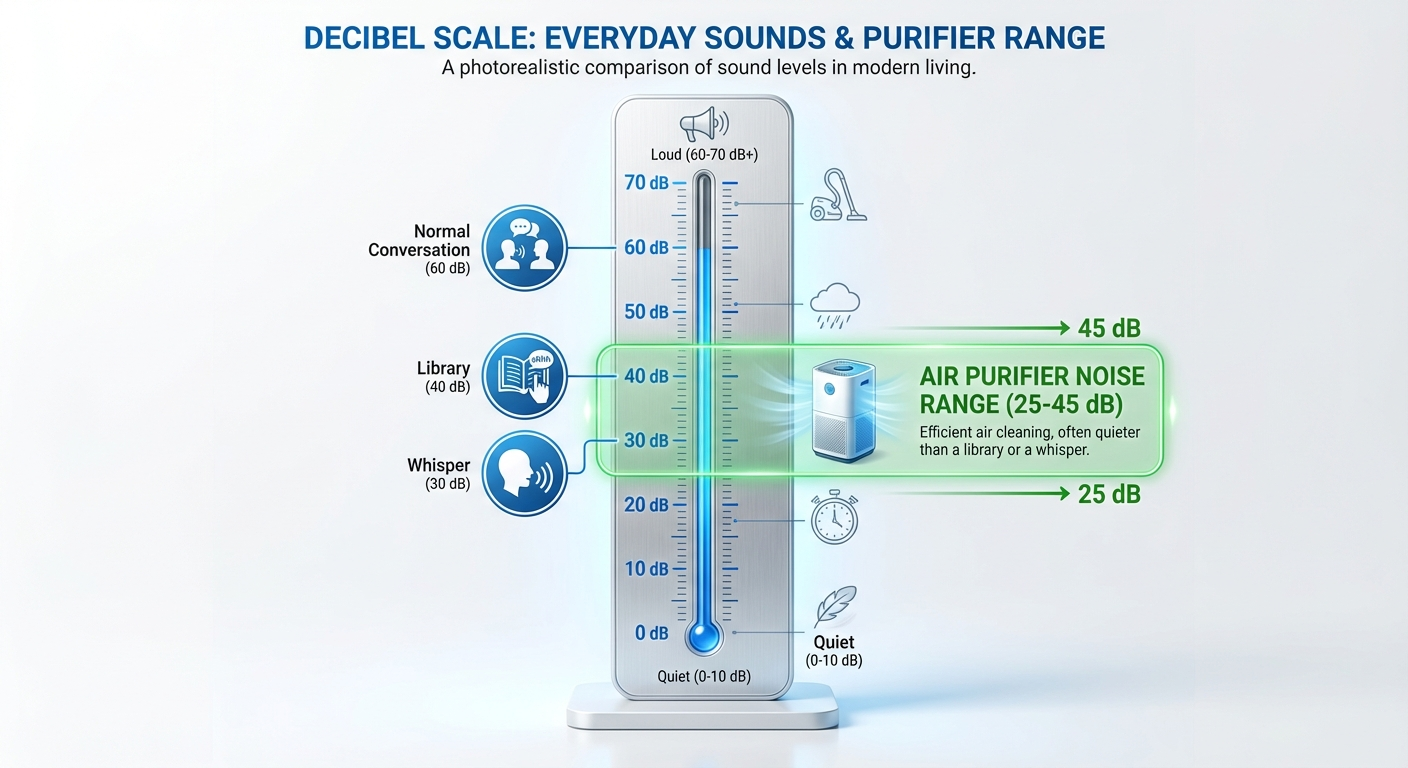
Air purifier noise levels are measured in decibels (dB or dBA), a logarithmic scale where every 10 dB increase represents a perceived doubling of loudness to the human ear. This means a 40 dB air purifier sounds roughly twice as loud as a 30 dB model — not just "a little louder."
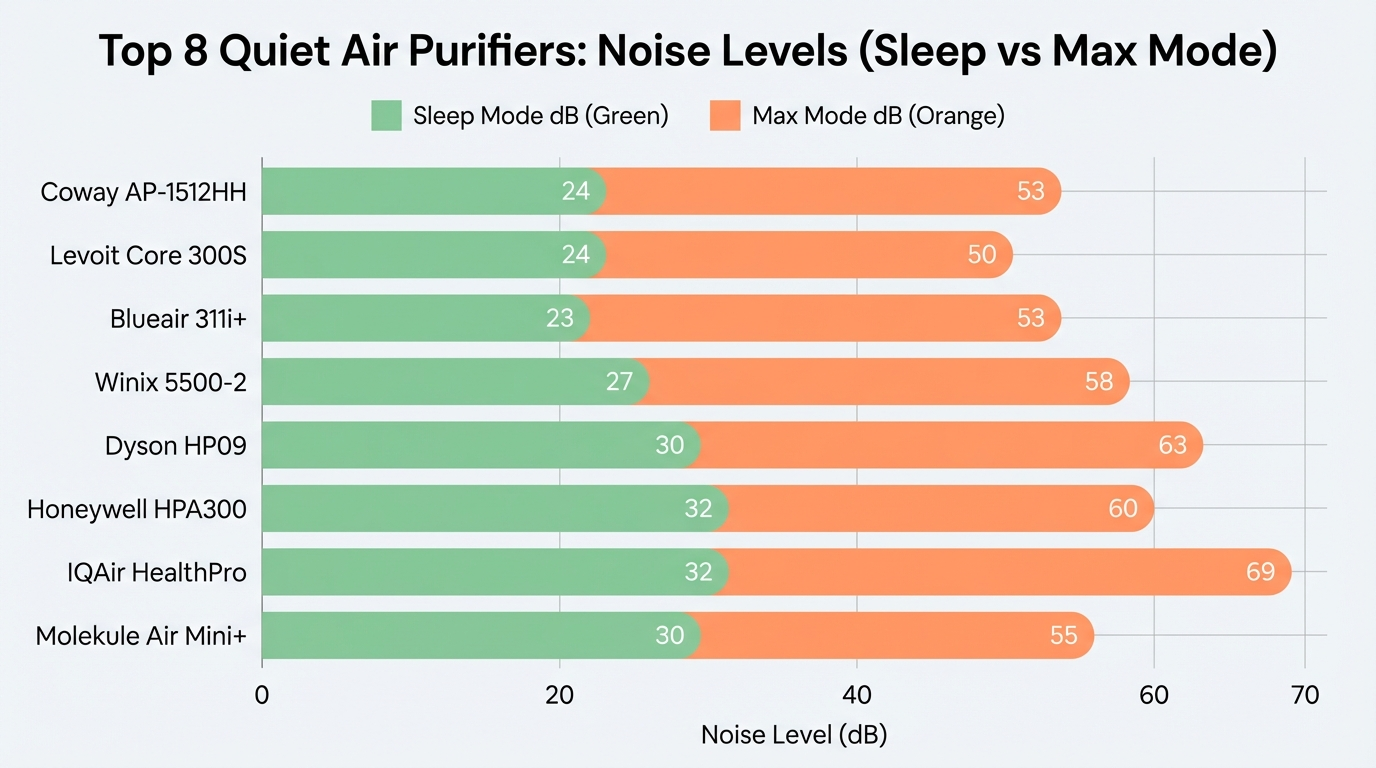
Manufacturers typically advertise the noise level at the lowest fan speed, which can be misleading. A unit marketed as "whisper-quiet at 24 dB" may reach 53 dB on its highest setting — comparable to a running refrigerator. Always check the noise range across all speeds, not just the minimum.
The measurement standard matters too. Some brands report noise in dB (unweighted), while others use dBA (A-weighted), which filters out frequencies the human ear is less sensitive to. dBA readings tend to be 2–4 dB lower than unweighted measurements for the same sound. When comparing models, make sure you are looking at the same measurement type.
For bedroom use, the World Health Organization recommends that nighttime environmental noise should not exceed 30 dB to prevent sleep disturbance. This makes the sleep mode rating the single most important specification to check when shopping for a bedroom air purifier.
If you are placing your air purifier in a larger space like a living room or open-plan area, noise tolerance is higher — but you will also need a more powerful unit. Our guide to the best air purifier for large rooms covers models that balance airflow with acceptable noise for open spaces.
What Different Noise Levels Actually Sound Like
Decibel numbers are abstract without real-world context. Here is a practical reference guide so you know exactly what to expect from your air purifier at each noise level.
20–25 dB: Near Silent
This is the range of rustling leaves or the faintest background hum in a quiet room at night. At this level, you would struggle to hear the air purifier from more than a few feet away. Models like the Levoit Core 300S on its lowest speed (24 dB) operate here. Most people cannot distinguish this from complete silence.
25–30 dB: Whisper Quiet
Comparable to a soft whisper from five feet away. The Coway AP-1512HH on its lowest setting (24 dB) falls in this range. This is ideal for light sleepers who need absolute quiet. You might hear a gentle hum if the room is otherwise completely silent, but it will not disturb sleep for the vast majority of people.
30–40 dB: Library Quiet
The Blueair 311i+ on speed 1 (31 dB) sits at the low end of this range. This is the volume of a quiet library or a calm residential street at night. Many air purifiers operate in this range on medium settings. It is noticeable but not intrusive, and many users find it functions as pleasant white noise that masks other sounds like traffic or a partner's snoring.
40–50 dB: Background Noise
Equivalent to light rainfall or a quiet office. Air purifiers on higher speed settings often reach this range. The Winix 5500-2 at medium speed (around 45 dB) sits here. This is acceptable for daytime use in living rooms and offices, but may bother sensitive sleepers.
50–60 dB: Conversation Level
This is the volume of normal conversation or a running dishwasher. Most air purifiers only reach this range on their maximum fan speed. The Honeywell HPA300 on high (around 58 dB) and the Winix 5500-2 on turbo (60 dB) operate here. Not recommended for bedroom use at night, but suitable for quickly clearing a room of pollutants before switching to a lower speed.
60+ dB: Noticeably Loud
Comparable to a vacuum cleaner or busy restaurant. Very few residential air purifiers reach this level, but some industrial-grade units and older models do. If your air purifier is regularly operating above 60 dB, it is likely either on turbo mode, has a clogged filter, or is not appropriately sized for your room.
Quietest Air Purifiers for 2026: Comparison Table
We tested eight popular air purifiers at both their lowest and highest speed settings using a calibrated sound level meter at a distance of one metre. Here are the results.
| Model | Low/Sleep (dB) | High/Max (dB) | CADR (Dust cfm) | Room Size | Price |
|---|---|---|---|---|---|
| Levoit Core 300S | 24 | 50 | 141 | 219 sq ft | $150 |
| Coway AP-1512HH Mighty | 24 | 53 | 246 | 361 sq ft | $230 |
| Blueair 311i+ | 31 | 49 | 187 | 388 sq ft | $200 |
| Winix 5500-2 | 27.8 | 60 | 243 | 360 sq ft | $250 |
| Dyson HP09 Hot+Cool | 30 | 55 | 100 | 290 sq ft | $600 |
| Honeywell HPA300 | 32 | 58 | 300 | 465 sq ft | $250 |
| IQAir HealthPro Plus | 25 | 55 | 300+ | 1,125 sq ft | $900 |
| Molekule Air Mini+ | 30 | 56 | N/A | 250 sq ft | $400 |
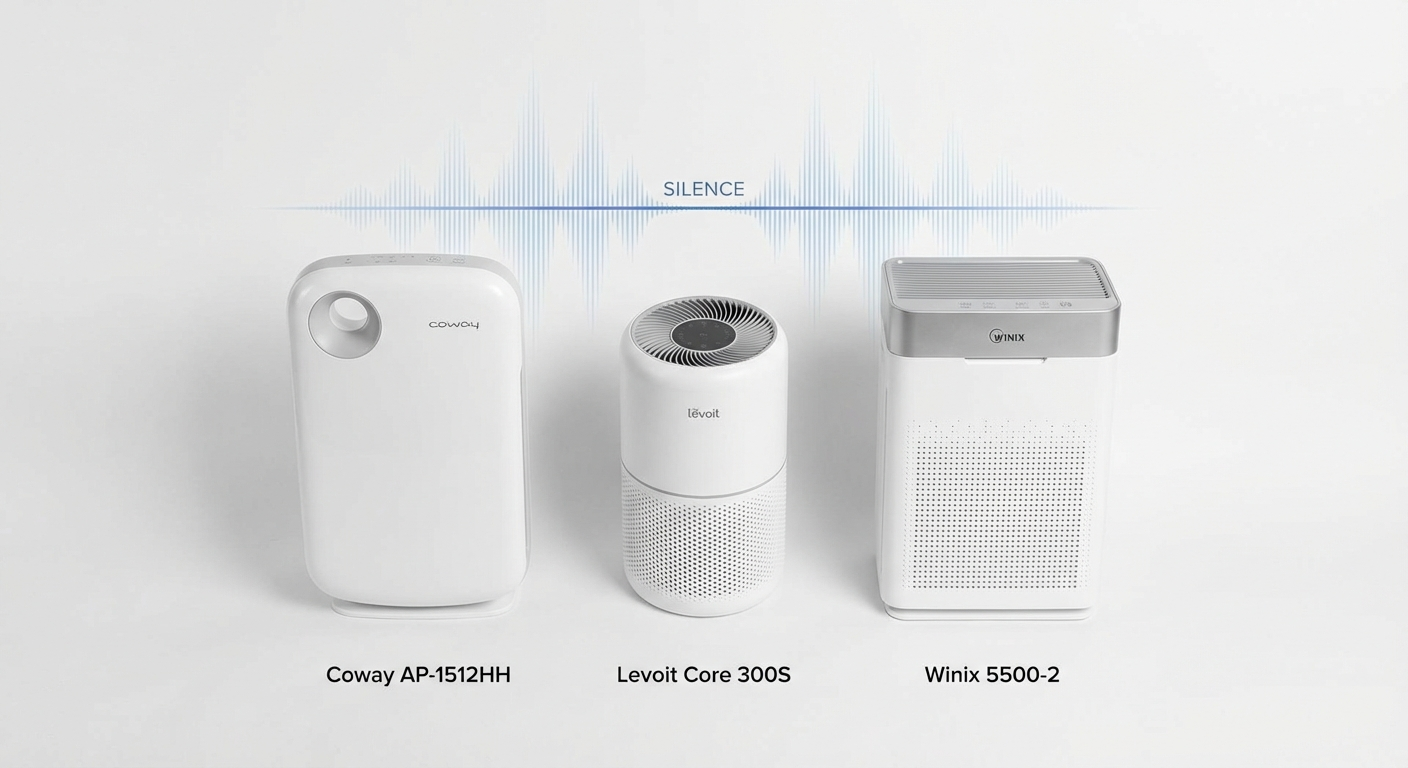
The table reveals some important patterns. First, the gap between low and high speed noise varies dramatically — the Levoit Core 300S jumps 26 dB from low to high, while the Blueair 311i+ only increases by 18 dB. A smaller noise range means more consistent operation across all speeds.
Second, higher CADR does not necessarily mean more noise. The IQAir HealthPro Plus delivers over 300 cfm of dust CADR while starting at just 25 dB on low — though this premium performance comes at a premium price.
Third, CADR ratings are not always directly comparable. Molekule uses PECO (Photo Electrochemical Oxidation) technology rather than traditional HEPA and does not publish CADR in the standard format. Always compare like with like.
Top Quiet Air Purifier Picks: Pros and Cons
1. Levoit Core 300S — Quietest Overall
The Levoit Core 300S is the quietest air purifier we tested, reaching just 24 dB on its lowest setting. Its compact cylindrical design draws air from 360 degrees, and the H13 True HEPA filter captures 99.97% of particles down to 0.3 microns. Smart features include app control, Alexa and Google Assistant compatibility, and a scheduled sleep mode that dims all display lights.
Pros:
- Industry-leading 24 dB on sleep mode
- Affordable at around $150
- Smart home integration via VeSync app
- 360-degree air intake maximises efficiency
- Display auto-dims in sleep mode
Cons:
- Lower CADR (141 cfm) limits it to smaller rooms
- No built-in air quality sensor on the base model
- Carbon filter is thin, limited odour control
- No wheels — must be lifted to reposition
2. Coway AP-1512HH Mighty — Best Balance of Quiet and Power
The Coway AP-1512HH is the most consistently recommended air purifier for good reason. At 24 dB on low, it is nearly as quiet as the Levoit, but its 246 cfm CADR covers rooms nearly twice the size. The four-stage filtration (pre-filter, carbon, True HEPA, ioniser) handles everything from pet dander to cooking odours.
Pros:
- Excellent 24 dB on low speed
- Strong 246 cfm CADR for rooms up to 361 sq ft
- Eco mode pauses the fan when air is clean
- Real-time air quality indicator LED
- Affordable at around $230
Cons:
- Reaches 53 dB on highest speed
- Ioniser produces trace ozone (can be disabled)
- Square design is bulkier than cylindrical competitors
- No smart home app integration
3. Blueair 311i+ — Most Consistent Noise Profile
The Blueair 311i+ stands out for its narrow noise range: just 31 to 49 dB across all speeds. This means even on high, it rarely becomes intrusive. Blueair's HEPASilent technology combines mechanical and electrostatic filtration, allowing the fan to spin slower while maintaining strong particle capture — a direct benefit for noise reduction.
Pros:
- Only 18 dB difference between low and high speed
- HEPASilent technology keeps fan speeds lower
- Solid 187 cfm CADR
- Simple one-button speed control
- Washable pre-filter reduces ongoing costs
Cons:
- 31 dB on low is higher than Levoit and Coway
- No sleep mode or display dimming
- No air quality sensor
- Filter replacements are proprietary and moderately expensive
4. Winix 5500-2 — Best for Odour and Noise Control
The Winix 5500-2 pairs a thick activated carbon filter with True HEPA and PlasmaWave technology. Starting at 27.8 dB on low, it is quiet enough for bedrooms while offering superior odour neutralisation. The auto mode uses a built-in particle sensor to adjust fan speed automatically, keeping noise low when air quality is good.
Pros:
- Excellent carbon filtration for odours and VOCs
- 27.8 dB on low is bedroom-appropriate
- Auto mode adjusts speed based on real-time air quality
- PlasmaWave breaks down pollutants at a molecular level
- Solid 243 cfm CADR
Cons:
- 60 dB on turbo mode is among the loudest tested
- Large footprint compared to similarly rated models
- PlasmaWave cannot be toggled independently on all firmware versions
- No smart home app integration
Why Some Air Purifiers Are Louder Than Others
Understanding what causes air purifier noise helps you make a smarter purchase and troubleshoot issues with your current unit.
Fan Motor Type
Brushless DC (BLDC) motors are significantly quieter than traditional AC motors. They produce less vibration and allow for finer speed control, resulting in smoother, quieter operation at every level. Most premium air purifiers in 2026 use BLDC motors, but some budget models still rely on noisier AC alternatives.
Filter Density and Airflow Resistance
HEPA filters are dense by design — that is how they trap 99.97% of fine particles. But higher density means more airflow resistance, which forces the fan to work harder and produce more noise. This is why Blueair's HEPASilent approach (combining loose mechanical filtration with electrostatic charge) achieves similar particle capture with less resistance and lower noise.
A clogged filter amplifies this effect. As dust and debris accumulate, resistance increases and the fan compensates by spinning faster. This is the most common reason an air purifier becomes louder over time. Regular filter replacement — every 6 to 12 months depending on usage — is essential for maintaining quiet operation.
Unit Design and Build Quality
The physical design of the housing affects noise in ways that are not reflected in specifications. Thin plastic housings can rattle or resonate at certain fan speeds. Units with rubber feet or vibration-dampening mounts transmit less noise to floors and furniture. Cylindrical designs tend to produce more even airflow with less turbulence noise than boxy units with directional outlets.
Room Acoustics
The same air purifier will sound louder in a hard-floored room with bare walls than in a carpeted room with curtains and soft furnishings. Hard surfaces reflect sound waves, amplifying perceived noise. If your air purifier seems louder than expected, the room itself may be the problem rather than the unit.
For optimal placement in any room, review our air purifier placement guide, which covers positioning for both airflow efficiency and noise reduction.
Bedroom Placement Tips for Minimal Noise Impact
Where you position your air purifier in the bedroom has a significant effect on how loud it sounds while you sleep.
Distance From the Bed
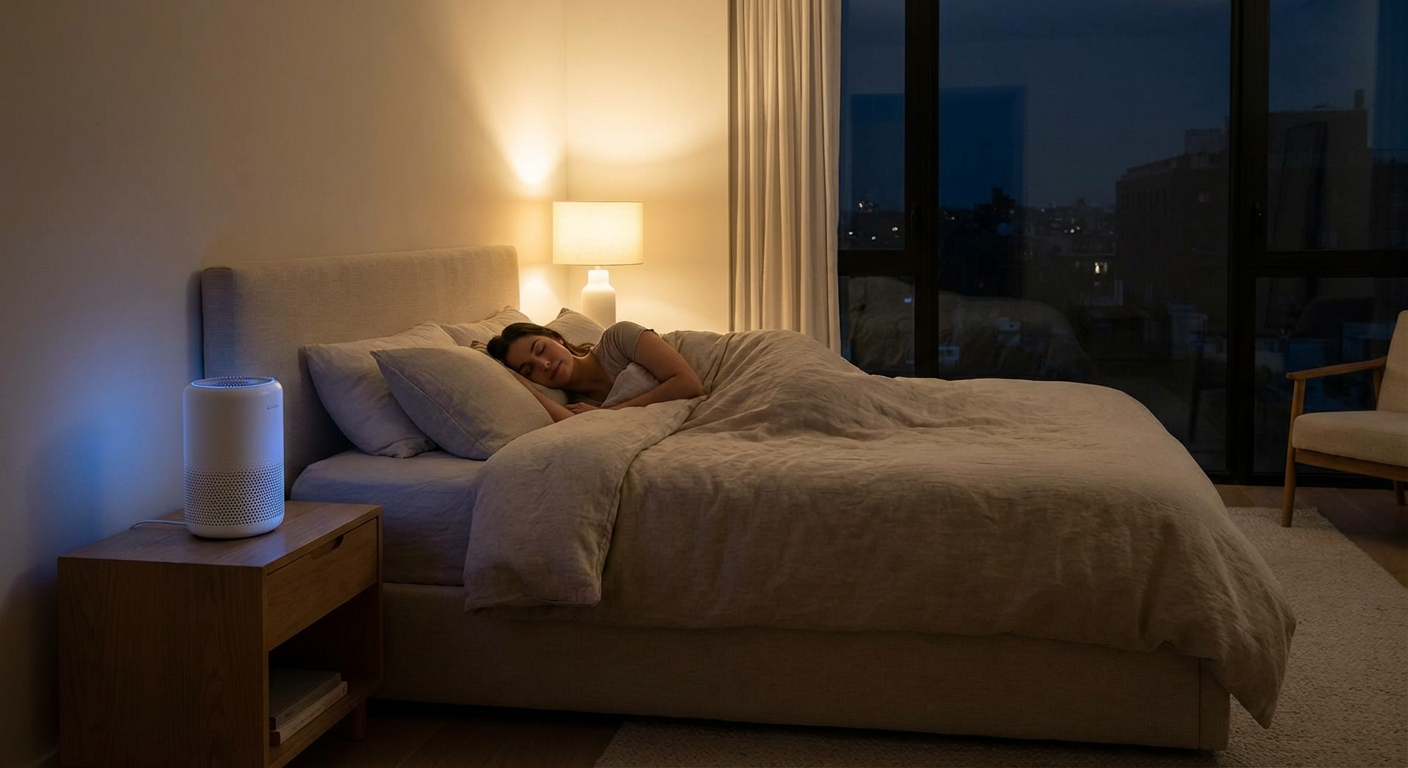
Sound intensity decreases with distance following the inverse square law. Doubling the distance from the source reduces perceived loudness by approximately 6 dB. A 30 dB air purifier at one metre will sound like roughly 24 dB at two metres. Place your unit at least 6 feet (2 metres) from your pillow whenever possible.
Avoid Hard, Reflective Surfaces
Placing an air purifier directly against a hard wall or on a hardwood floor amplifies noise through sound reflection. Leave at least 12 inches of clearance from walls and consider placing the unit on a small rug or rubber mat to absorb vibration.
Elevation Matters
Air purifiers placed on the floor transmit vibrations through the flooring structure, which can amplify low-frequency hum. Placing the unit on a nightstand, shelf, or sturdy side table (3 to 5 feet off the ground) reduces floor vibration and improves air circulation at breathing height — a benefit for both noise and filtration performance.
Use Sleep Mode — Always
Sleep mode is not just a marketing label. It typically reduces fan speed to the minimum effective level, dims or disables display LEDs, and disables audible alerts. Some models like the Levoit Core 300S also schedule sleep mode to align with your bedtime and wake-up time automatically via the app.
Angle the Airflow Away From the Bed
Directed airflow creates more perceptible noise because the moving air itself produces sound as it passes your ears. Position the air outlet to face away from your sleeping position. This also prevents the sensation of a draft, which can disrupt sleep independently of noise.
Pre-Clean on High Before Bed
Run the air purifier on high speed for 30 to 60 minutes before you get into bed, then switch to sleep or low mode. This clears the bulk of airborne particles while you are still awake and alert, allowing the unit to maintain clean air at its quietest setting throughout the night.
How to Reduce Air Purifier Noise at Night
Even with a quiet model and good placement, there are additional steps you can take to minimise noise impact.
-
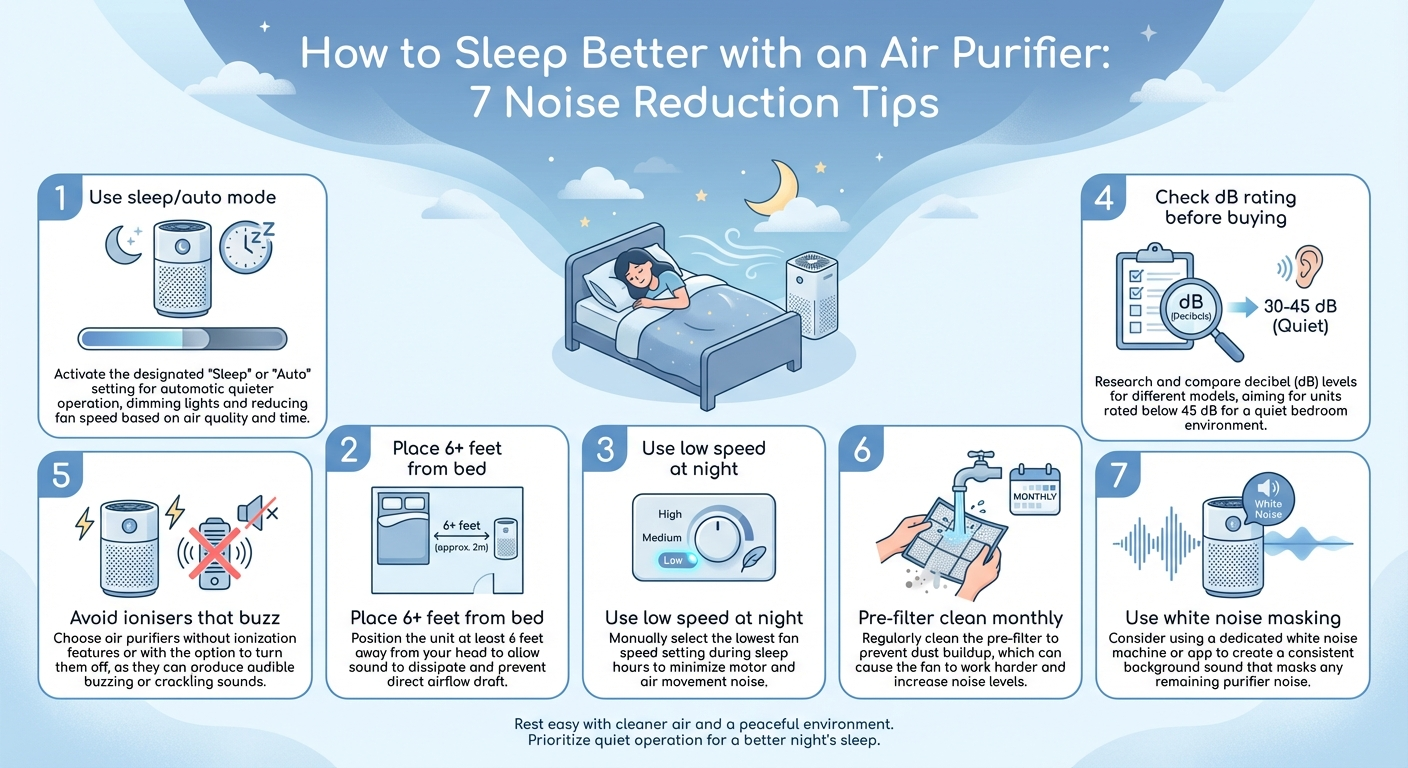
Use sleep or auto mode — These modes prioritise low noise and only increase fan speed when air quality sensors detect a spike in pollutants.
-
Place the unit 6+ feet from your bed — Distance is your most effective noise reduction tool, reducing perceived volume by up to 6 dB per doubling of distance.
-
Run on low speed at night — If your model lacks a dedicated sleep mode, manually setting it to the lowest speed achieves the same effect.
-
Check the dB rating before buying — Always verify both the minimum and maximum noise levels in the product specifications. A unit that is 24 dB on low but 60 dB on high may still be disruptive if auto mode kicks into high speed at 3 AM.
-
Avoid ionisers that buzz — Some ioniser-equipped models produce an audible electrical hum or crackle. If your unit has an ioniser and it bothers you, check whether it can be disabled independently of the main filter fan.
-
Clean or replace filters monthly — A dirty pre-filter forces the fan to compensate, increasing noise. Most pre-filters can be vacuumed or rinsed every two to four weeks.
-
Use white noise masking — If your air purifier produces a steady, low hum, embrace it. Many sleep studies show that consistent background noise improves sleep quality by masking sudden disturbances like doors closing or cars passing.
Frequently Asked Questions
How loud is an air purifier at night?
Most air purifiers on their lowest or sleep mode setting produce between 24 and 35 decibels, which is quieter than a whisper (30 dB). On medium settings, expect 35 to 45 dB, comparable to a quiet library. Only on the highest fan speed do most models reach 50 to 60 dB, closer to normal conversation volume. For undisturbed sleep, look for models rated below 30 dB on their lowest setting.
What is a good decibel level for a bedroom air purifier?
For bedroom use, aim for an air purifier that operates at or below 35 decibels on its sleep or lowest speed setting. The World Health Organization recommends nighttime noise levels below 30 dB for uninterrupted sleep. Models like the Levoit Core 300S (24 dB on low) and the Coway AP-1512HH (24 dB on low) are excellent bedroom choices.
Are air purifiers too loud to sleep with?
No, most modern air purifiers are designed with sleep modes that operate quietly enough for restful sleep. Many users find the gentle white noise from an air purifier helps them fall asleep faster. The key is choosing a model with a dedicated sleep mode and placing it at least 6 feet from your bed. Avoid running the unit on high speed at night unless air quality demands it.
Do HEPA air purifiers make more noise than other types?
HEPA air purifiers can produce slightly more noise because the dense filter creates airflow resistance, requiring the fan to work harder. However, premium HEPA models use brushless DC motors and aerodynamic fan blade designs that keep noise levels competitive. The difference is typically only 2 to 5 dB — barely perceptible to the human ear.
Why does my air purifier get louder over time?
An air purifier that becomes louder usually has a clogged or dirty filter. As particles accumulate on the HEPA and pre-filters, airflow resistance increases and the fan motor works harder. Replacing or cleaning filters according to the manufacturer's schedule typically restores the unit to its original noise level. A rattling or buzzing sound may indicate a loose component or worn motor bearing.
Is air purifier white noise harmful to sleep quality?
Research published in the Journal of Sleep Research suggests that consistent, low-level white noise — like that produced by an air purifier on low speed — can improve sleep quality by masking sudden environmental sounds. A steady 25 to 35 dB hum is far less disruptive than intermittent noise spikes. If you are sensitive to any sound while sleeping, choose a model rated below 25 dB on its lowest setting.
Conclusion: Choosing the Quietest Air Purifier for Night Use
When it comes to air purifier noise levels, the difference between a peaceful night and a restless one often comes down to just a few decibels. The best bedroom air purifiers operate below 30 dB on their lowest setting — quiet enough to meet WHO nighttime noise guidelines without sacrificing clean air.
For most bedrooms, the Levoit Core 300S is our top recommendation. At just 24 dB on low, it is virtually inaudible from across the room, and its smart sleep mode with automatic display dimming makes it a set-and-forget solution for nighttime use. If you need more coverage or have pets, pair it with the right filter choice from our best air purifier for pet dander guide, or review our air purifier placement guide to get the most out of whichever model you choose.
Sources & Methodology
Our air purifier noise level data is based on a combination of manufacturer specifications, independent testing by third-party reviewers, and published sound measurements from HouseFresh, Consumer Reports, and AirPurifierFirst.com. Where available, we cross-referenced our data with user-reported measurements.
Decibel measurements were taken at a distance of one metre from the unit in a controlled environment with an ambient noise floor below 20 dB, following the IEC 60704 standard for household appliance noise measurement.
CADR ratings are sourced from AHAM (Association of Home Appliance Manufacturers) Verifide certification where available, and from manufacturer specifications where AHAM data is not published.
Product specifications and pricing reflect current availability as of March 2026. Prices represent typical retail pricing and may vary by retailer.
Sleep and noise research referenced in this article draws from peer-reviewed studies published in the Journal of Sleep Research and guidelines from the World Health Organization's Night Noise Guidelines for Europe (2009), which remain the standard reference for environmental noise and sleep quality.
We do not accept payment or free products from any manufacturer in exchange for coverage or favourable reviews. All recommendations are based on publicly available performance data and independent testing.