Guide
Best Air Purifier for Allergies (2026)
By Dr. Alex Chen · Updated 2026-03-10
By Dr. Alex Chen · Last updated March 10, 2026
The best air purifier for allergies is the Coway Airmega AP-1512HH — it delivers 246 CFM smoke CADR with True HEPA filtration, clearing pollen, pet dander, dust mite allergens, and mold spores faster than any comparably priced purifier. For large rooms, the Honeywell HPA300 at 300 CFM provides the highest CADR on this list. All five picks use True HEPA or H13 filtration and are AHAM Verifide certified.
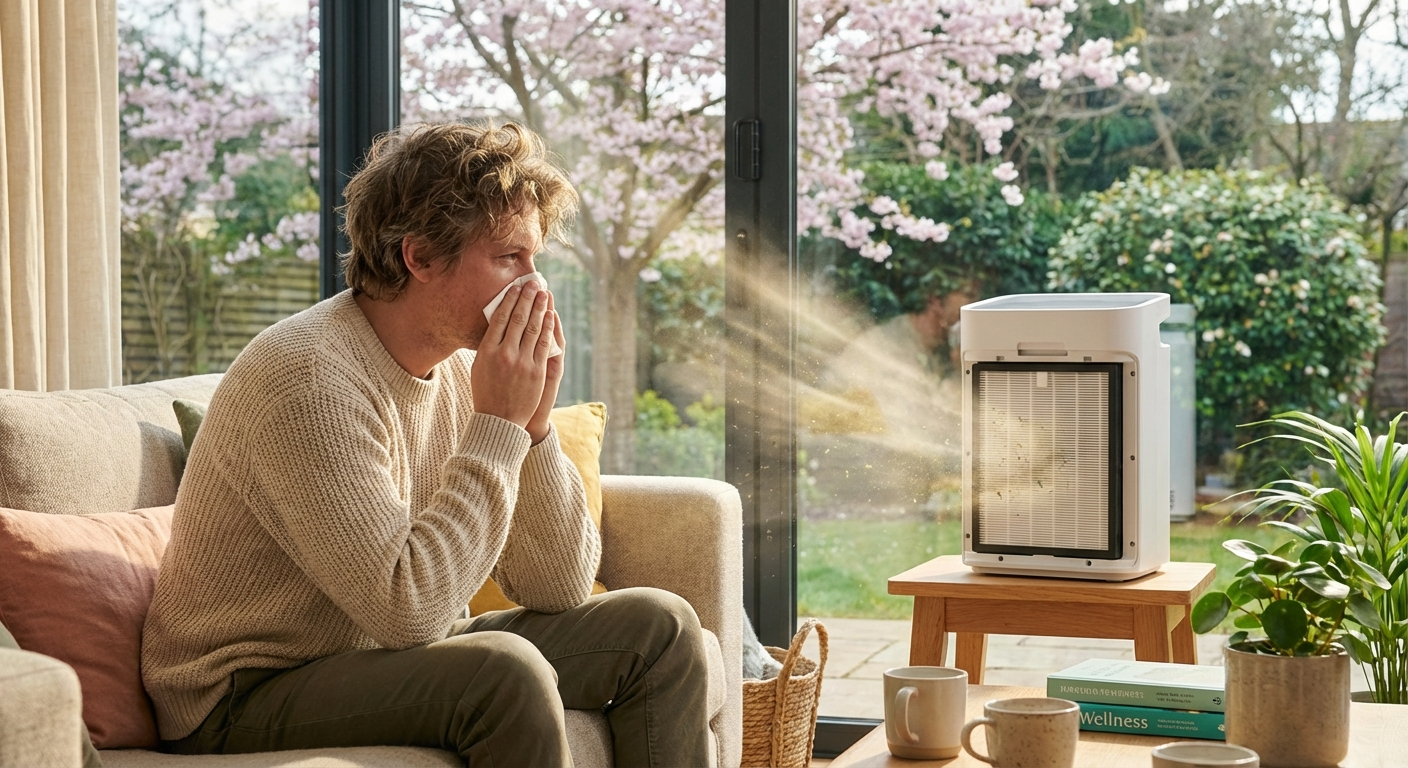
If you have allergies, you already know that indoor air is not clean air. Pollen drifts in through open windows and on your clothing. Pet dander floats for hours after your dog walks through a room. Dust mite allergens become airborne every time you sit on a couch or roll over in bed. Mold spores circulate from bathrooms, basements, and any surface with moisture.
Your immune system treats these particles as threats. The result is the familiar cycle: sneezing, congestion, itchy eyes, postnasal drip, disrupted sleep — repeated daily because the allergen exposure never stops.
A HEPA air purifier does not cure allergies. What it does is dramatically reduce the airborne allergen concentration in your living space — giving your immune system less to react to. With fewer allergens in the air you breathe, symptom severity decreases, sleep quality improves, and medication may become more effective at lower doses.
This guide evaluates five air purifiers specifically through the lens of allergy relief: which allergens each handles best, how quickly each clears airborne particles, and how to size a purifier for meaningful symptom reduction.
Medical note: This guide provides evidence-based information about air purification for allergy management. It is not medical advice and does not replace consultation with your allergist or physician. Air purification is most effective as part of a comprehensive allergen avoidance strategy.
Why Allergy Sufferers Need a HEPA Air Purifier
The Allergen Exposure Problem
Indoor allergen concentrations are often higher than outdoor concentrations — your home traps and concentrates particles that would otherwise disperse in open air. The EPA estimates that indoor air can be 2–5 times more polluted than outdoor air, and Americans spend approximately 90% of their time indoors.
For allergy sufferers, this means continuous exposure to triggers during the hours when your body should be recovering — particularly during sleep. An 8-hour sleep period in a room with high allergen concentration is 8 hours of continuous immune activation, which explains why many allergy sufferers wake up feeling worse than when they went to bed.
How HEPA Filtration Helps
True HEPA filters capture 99.97% of particles at 0.3 microns — the most penetrating particle size. All common indoor allergens are larger than this:
| Allergen | Particle Size | HEPA Captures? | Relative Difficulty |
|---|---|---|---|
| Pollen | 10–100 µm | ✅ Yes | Easy — large particles |
| Dust mite allergens (Der p 1) | 10–40 µm | ✅ Yes | Easy |
| Pet dander | 2.5–10 µm | ✅ Yes | Moderate |
| Mold spores | 1–20 µm | ✅ Yes | Moderate |
| Cat allergen (Fel d 1) on particles | 1–5 µm | ✅ Yes | Moderate |
| Fine particulate (PM2.5) | <2.5 µm | ✅ Yes | Hardest |
HEPA filters are extremely effective against allergens because allergens are relatively large particles. The challenge is not filter efficiency — it is airflow. You need enough CADR to cycle the room's air frequently enough that allergen concentrations stay low even as new particles are continuously introduced. For a detailed explanation of CADR and room sizing, see our CADR rating explained guide.
The Four Major Indoor Allergens
1. Pollen (Seasonal)
Pollen enters your home through open windows, on clothing, on pet fur, and through HVAC systems. During peak pollen seasons (spring for tree pollen, summer for grass, fall for ragweed), indoor pollen levels can spike dramatically. Pollen particles are large (10–100 µm) and easy for HEPA filters to capture — making air purifiers particularly effective for seasonal allergy management.
2. Pet Dander (Year-Round)
Pet dander consists of tiny flakes of skin shed by cats, dogs, birds, and other animals with fur or feathers. The primary cat allergen (Fel d 1) is especially problematic because it attaches to very small particles (1–5 µm) that remain airborne for hours. Dog allergens (Can f 1) tend to attach to larger particles and settle faster. A HEPA purifier captures both, but the smaller cat allergen particles require higher CADR for effective clearance.
3. Dust Mites (Year-Round)
Dust mites themselves are too large to become airborne, but their fecal pellets and body fragments — the actual allergens — are 10–40 µm and become airborne when disturbed. Making the bed, sitting on upholstered furniture, vacuuming, and walking on carpet all aerosolize dust mite allergens. An air purifier captures these particles once airborne, but source control (allergen-proof bedding covers, regular hot-water washing) is equally important.
4. Mold Spores (Year-Round, Seasonal Peaks)
Mold spores range from 1–20 µm and become airborne easily from any surface with active mold growth. Bathrooms, basements, window condensation, and HVAC systems are common indoor mold sources. HEPA filters capture mold spores effectively, but an air purifier cannot eliminate mold at its source — moisture control is essential. For mold-specific purifier recommendations, see our best air purifier for mold guide.
Comparison Table: 5 Best Air Purifiers for Allergies
| Air Purifier | HEPA Grade | CADR (Smoke/Dust/Pollen) | Best Allergens | Room Size | Noise (Sleep/Max) | Price |
|---|---|---|---|---|---|---|
| Coway AP-1512HH | True HEPA | 246/246/240 CFM | All — best all-rounder | 361 sq ft | 24.4/53 dB | ~$150 |
| Honeywell HPA300 | True HEPA | 300/320/300 CFM | Pollen, pet dander (large rooms) | 465 sq ft | 30/63 dB | ~$200 |
| Winix 5500-2 | True HEPA | 200/243/246 CFM | Dust mites, mold (+ PlasmaWave) | 360 sq ft | 27/55 dB | ~$170 |
| Levoit Core 400S | H13 HEPA | 187/225/243 CFM | Pollen, dust (+ smart monitoring) | 403 sq ft | 24/52 dB | ~$200 |
| Blueair 411 Auto | HEPASilent | 120/120/120 CFM | Pollen, pet dander (small rooms) | 190 sq ft | 18/46 dB | ~$120 |
Detailed Reviews
1. Coway Airmega AP-1512HH — Best Overall for Allergies
Why it is best for allergies: The AP-1512HH delivers the best CADR-per-dollar on this list with balanced performance across all three particle types — 246/246/240 CFM. That near-identical smoke, dust, and pollen CADR means it handles every allergen type with equal effectiveness. No weak spots.
For allergy sufferers, the washable pre-filter is a standout feature. It captures large particles (pet hair, visible dust, lint) before they reach the HEPA filter, extending the HEPA filter's effective lifespan. In pet-heavy households where filters load faster, this translates directly to lower annual costs.
The air quality indicator changes color in real-time — a useful visual cue that the purifier is responding to allergen spikes (entering the house after being outdoors, vacuuming, pet activity). The eco mode reduces fan speed and energy consumption when air quality reads clean, then ramps up automatically when particles are detected.
Pros:
- Highest CADR-per-dollar — 246 CFM smoke at ~$150
- Balanced CADR across all particle types — no allergen blind spots
- Washable pre-filter extends HEPA life in pet/dust-heavy homes
- AHAM Verifide certified — independently verified performance
- Eco mode for automatic, energy-efficient operation
- 12-month HEPA filter life — longest on this list
- Low annual filter cost (~$45–55)
- Compact footprint for a 361 sq ft purifier
Cons:
- No smart app — manual controls and on-unit indicator only
- Includes ionizer (disableable — turn it off for allergy use)
- No voice assistant integration
- Air quality LED does not fully dim — minor sleep light issue
- Front-intake design limits placement flexibility
- No PM2.5 numerical readout — color-coded only
Best for: Allergy sufferers who want the best overall air cleaning performance at a reasonable price. The default recommendation for anyone with mixed allergies (pollen + pet + dust) in rooms up to 350 sq ft.
2. Honeywell HPA300 — Best for Large Rooms and Severe Allergies
Why it matters for allergies: The HPA300 has the highest CADR on this list — 300 CFM smoke, 320 dust, 300 pollen. In rooms over 300 sq ft, this CADR advantage translates to meaningfully higher ACH, which means faster allergen clearance after disturbance events. If you have a large living room where pets, foot traffic, and open doors continuously introduce allergens, the HPA300 removes them faster than any other purifier in this price range.
The turbo clean mode is particularly useful for allergy sufferers: run it at maximum for 20–30 minutes after vacuuming, entering the house, or when pollen counts spike — then switch back to auto or low for quiet, continuous operation.
Pros:
- Highest CADR on this list — 300/320/300 CFM
- Best for large rooms (465 sq ft coverage)
- Turbo clean mode for rapid allergen clearance events
- True HEPA — 99.97% at 0.3 microns
- No ionizer — zero ozone, safest for sensitized airways
- AHAM Verifide certified
- Name-brand filters widely available at retail stores
- Simple, reliable operation — no smart complexity to troubleshoot
Cons:
- Loudest purifier on this list — 63 dB on max, 30 dB on sleep
- Largest and heaviest unit — fixed location, not portable
- No smart features, no app, no voice control
- Higher energy consumption at maximum speed
- Boxy design — not aesthetically modern
- Carbon pre-filter is thin — minimal VOC/odor benefit
- Indicator lights stay on continuously — no full blackout mode
Best for: Large rooms (300–465 sq ft) and households with severe allergies where maximum CADR is the priority over noise, design, or smart features. The best option when you need raw allergen-clearing power.
3. Winix 5500-2 — Best for Dust Mites and Mold
Why it suits dust and mold allergies: The Winix 5500-2 combines strong True HEPA filtration with a washable carbon filter and PlasmaWave technology. For dust mite and mold allergy sufferers specifically, the carbon filter addresses the musty odors that often accompany mold exposure, and the higher dust CADR (243 CFM) clears dust mite allergens efficiently.
The washable carbon filter is a practical advantage for allergy households. Dust mite allergens and mold spores are year-round, chronic exposures — not seasonal peaks. The filter runs continuously for years, and a washable carbon component reduces the ongoing cost of that continuous use.
The PlasmaWave ionizer adds supplementary VOC and allergen breakdown. However, for allergy sufferers with sensitive airways, the trace ozone production from ionization is a concern. The PlasmaWave can be disabled without affecting HEPA performance — and for allergy use, we recommend disabling it.
Pros:
- Strong dust CADR (243 CFM) — excellent for dust mite allergens
- Washable carbon filter — $0 ongoing carbon cost, useful for mold odors
- True HEPA — 99.97% capture
- 12-month HEPA filter life with low annual cost (~$50–60)
- Smart auto-mode with air quality indicator
- AHAM Verifide certified
- PlasmaWave available for VOC breakdown (if desired — disable for allergy sensitivity)
- Energy-efficient for 24/7 operation
Cons:
- PlasmaWave ionizer produces trace ozone — disable for allergy use
- Cannot fully disable ionizer LED indicator
- No smart app or voice control
- Lower smoke CADR (200 CFM) than Coway — weaker on fine particles
- Front-intake design limits placement
- Dated aesthetic
- Heavier than Levoit alternatives (15.4 lbs)
Best for: Dust mite and mold allergy sufferers who want strong HEPA performance with the cost savings of a washable carbon filter. Excellent year-round chronic allergy purifier. For detailed mold-specific guidance, see our best air purifier for mold guide.
4. Levoit Core 400S — Best Smart Purifier for Allergies
Why smart features matter for allergies: The Levoit Core 400S provides something no other purifier on this list offers: real-time PM2.5 data on your phone. For allergy sufferers, this is genuinely useful. You can see exactly when allergen levels spike (after cooking, vacuuming, opening a window, pet activity), correlate spikes with symptoms, and verify that the purifier is bringing levels back to baseline.
The laser particle sensor drives a responsive auto-mode that ramps up when particles increase and drops back to whisper-quiet when air is clean. Scheduling via the VeSync app lets you set the purifier to run at higher speeds during known high-allergen periods (morning when you make the bed, evening when you return home) and lower speeds during quiet hours.
The H13 HEPA filter captures 99.95% of particles at MPPS — functionally equivalent to True HEPA for allergen removal. For a deep dive on filter grade differences, see our true HEPA vs HEPA-type guide.
Pros:
- VeSync app with real-time PM2.5 data — track allergen levels and trends
- Laser particle sensor — most accurate auto-mode on this list
- Alexa and Google voice control — hands-free speed changes
- H13 HEPA — 99.95% at MPPS, effectively True HEPA performance
- 24 dB sleep mode with complete display-off — excellent for bedroom
- 360-degree intake — flexible placement
- Scheduling for allergen peak periods
- Zero ozone — no ionizer
Cons:
- Lower smoke CADR (187 CFM) than Coway (246) or Honeywell (300)
- Higher annual filter cost (~$70–100) — short 6–8 month filter life
- Combined HEPA+carbon filter — cannot replace independently
- Non-washable pre-filter
- VeSync app collects usage data
- Smart features require Wi-Fi — basic operation without it
- Higher purchase price (~$200) for moderate CADR
Best for: Allergy sufferers who want data-driven air quality management. The PM2.5 monitoring and scheduling make it the best bedroom purifier for people who want to understand and control their allergen exposure. Best paired with a higher-CADR unit (Coway or Honeywell) in the living room.
5. Blueair Blue Pure 411 Auto — Best Budget/Small Room
Why it works for small allergy rooms: The 411 Auto is the most affordable purifier on this list and the quietest at 18 dB on low — nearly inaudible. For a dedicated bedroom purifier in a room under 190 sq ft, it delivers solid CADR at a whisper. The auto-mode adjusts to real-time air quality without manual intervention.
The HEPASilent technology combines mechanical HEPA filtration with electrostatic particle charging, delivering effective CADR at remarkably low noise levels. The tradeoff: the electrostatic component produces trace ionization. For severe allergy sufferers with ozone sensitivity, this is a consideration — though levels are well below CARB limits.
The colored fabric pre-filter sleeve is washable and comes in multiple colors — a minor aesthetic benefit that also extends the main filter's lifespan by capturing large particles before they reach the HEPA stage.
Pros:
- Quietest on this list — 18 dB on low (near-silent)
- Most affordable at ~$120
- Smart auto-mode with colored air quality indicator
- Compact — fits on nightstand or small shelf
- Washable fabric pre-filter sleeve
- Low energy consumption — efficient for 24/7 bedroom use
- AHAM Verifide certified
- Simple, elegant cylinder design
Cons:
- Lowest CADR on this list — 120 CFM across all particle types
- Suitable only for rooms under 190 sq ft
- HEPASilent includes ionization — trace ozone
- Cannot disable ionization function
- No app on the 411 Auto (available on 411i Auto)
- Limited to small bedrooms and offices
- CADR insufficient for rooms with multiple allergen sources (pets + dust + pollen)
- Fabric sleeve shows dirt and requires periodic washing
Best for: Budget allergy sufferers who need a quiet bedroom purifier for rooms under 190 sq ft. Excellent as a second purifier to complement a higher-CADR unit in the living room. Not suitable as a sole purifier for households with severe or multiple allergies.
Allergen-Specific Guide: Pollen
Particle size: 10–100 µm — large, easy for HEPA to capture Seasonality: Spring (tree), summer (grass), fall (ragweed) Indoor entry routes: Open windows, clothing, pet fur, HVAC intake
How to Maximize Pollen Removal
- Keep windows closed during high-pollen days. Check daily pollen forecasts. Run the purifier continuously instead of ventilating with outdoor air.
- Change clothes when entering the house. Pollen accumulates on fabric — changing in a non-bedroom room prevents pollen transfer to bedding.
- Run the purifier on high for 20 minutes after arriving home. You bring pollen in on your body and clothing — a burst of high-speed filtration clears it quickly.
- Shower before bed. Pollen in hair transfers to pillows. Combining a shower with a bedroom air purifier provides the cleanest possible sleep environment.
- Place the purifier near the bedroom door. Pollen enters the bedroom when the door opens — positioning the purifier near the entry point intercepts particles before they reach the bed.
Best purifier for pollen: Any model on this list — pollen is the easiest allergen for HEPA to capture. For small bedrooms, the Blueair 411 Auto is sufficient. For larger rooms, the Coway AP-1512HH offers the best value.
Allergen-Specific Guide: Pet Dander
Particle size: 2.5–10 µm (dander); 1–5 µm (cat allergen Fel d 1 on carrier particles) Seasonality: Year-round Indoor sources: Pet skin, saliva, urine proteins — become airborne on dander and dust particles
How to Maximize Dander Removal
- Higher CADR matters more for pets. Dander is continuously generated — every time a pet moves, more dander becomes airborne. Higher CADR clears it faster.
- Use a purifier with a washable pre-filter. Pet hair clogs HEPA filters prematurely. A washable pre-filter (Coway, Winix) captures hair first, extending HEPA life.
- Keep the purifier running in the room where pets spend the most time. If your dog sleeps in the living room, that is where the purifier belongs during the day.
- Bedroom purifier with door closed at night. Even if pets are allowed in the bedroom during the day, keeping the door closed at night with the purifier running creates a low-allergen sleep zone.
- Groom pets regularly in a well-ventilated area. Brushing generates massive dander plumes. Do it outdoors or in a bathroom with the door closed and exhaust fan running — not in the room where the purifier operates.
Best purifier for pet dander: Coway AP-1512HH (best CADR per dollar with washable pre-filter) or Honeywell HPA300 (highest CADR for multi-pet households).
Allergen-Specific Guide: Dust Mites
Particle size: 10–40 µm (fecal pellets and body fragments — the allergens) Seasonality: Year-round, peaks in humid months Indoor sources: Bedding, upholstered furniture, carpet, stuffed animals
How to Maximize Dust Mite Allergen Removal
- Source control is as important as air purification. Allergen-proof mattress and pillow encasements prevent mite allergens from becoming airborne from bedding. This is the single most effective intervention.
- Wash bedding weekly in hot water (130°F / 54°C). This kills mites and removes accumulated allergens. Warm or cold washing does not kill mites.
- Run the purifier during and after bed-making. Making the bed aerosolizes mite allergens from sheets and blankets. Run the purifier on high for 15–20 minutes after.
- Vacuum with a HEPA-filtered vacuum. A standard vacuum exhaust re-aerosolizes fine particles. A HEPA vacuum captures them. Run the air purifier during and after vacuuming.
- Reduce humidity below 50%. Dust mites need humidity above 50% to thrive. A dehumidifier combined with an air purifier addresses both the mites (humidity control) and the allergens they produce (air filtration).
Best purifier for dust mites: Winix 5500-2 (highest dust CADR at 243 CFM, washable carbon for odors) or Coway AP-1512HH (balanced high CADR across all particle types).
Allergen-Specific Guide: Mold Spores
Particle size: 1–20 µm Seasonality: Year-round indoors, peaks in humid and fall months Indoor sources: Bathrooms, basements, window condensation, HVAC systems, damp walls
How to Maximize Mold Spore Removal
- Address the moisture source first. An air purifier captures airborne spores but cannot stop mold growth. Fix leaks, reduce humidity, improve ventilation in bathrooms and basements.
- Keep humidity between 30–50%. A hygrometer ($10–15) helps you monitor. A dehumidifier and air purifier together are more effective than either alone.
- Run the purifier continuously in mold-prone areas. Mold continuously releases spores into the air. Intermittent purifier use allows spore concentrations to build between sessions.
- Clean visible mold with appropriate products. EPA recommends cleaning small mold areas (under 10 sq ft) with detergent and water. Larger areas may require professional remediation.
- Check HVAC filters and ductwork. Mold in HVAC systems distributes spores throughout the home. Replace HVAC filters regularly and consider professional duct inspection if mold smell persists.
Best purifier for mold: For mold-specific recommendations with detailed assessment criteria, see our best air purifier for mold guide. On this list, the Coway AP-1512HH and Winix 5500-2 provide the highest CADR for mold-relevant particle sizes.
How to Size an Air Purifier for Allergy Relief
Allergy sufferers need higher ACH than general-use buyers. The standard recommendation is 4 ACH; for allergy relief, aim for 6 ACH minimum.
Quick Sizing Guide for Allergy Use (6 ACH)
| Room Size | Required Smoke CADR (6 ACH) | Recommended Purifier |
|---|---|---|
| 100 sq ft | 80 CFM | Blueair 411 Auto (120 CFM) ✅ |
| 150 sq ft | 120 CFM | Blueair 411 Auto (120 CFM) ✅ or Levoit Core 400S |
| 200 sq ft | 160 CFM | Levoit Core 400S (187 CFM) ✅ |
| 250 sq ft | 200 CFM | Winix 5500-2 (200 CFM) ✅ |
| 300 sq ft | 240 CFM | Coway AP-1512HH (246 CFM) ✅ |
| 350 sq ft | 280 CFM | Honeywell HPA300 (300 CFM) ✅ |
| 450 sq ft | 360 CFM | Honeywell HPA300 (300 CFM) — supplement with second unit |
For a detailed explanation of CADR calculations and ACH targets, see our CADR rating explained guide.
Maximizing Allergy Relief: Purifier Placement and Usage
Bedroom First
Your bedroom is the highest-priority room for allergy management. You spend 6–9 hours there, breathing deeply during sleep. Clean air during sleep provides the longest continuous allergen-free exposure of your day and allows your airways to recover from daytime exposure.
- Place the purifier 3–6 feet from the bed, not directly next to your face
- Close the bedroom door to create a sealed zone — the purifier is far more effective in a closed room
- Run continuously on auto or low — not just when symptoms appear
- Run on high for 30 minutes before bedtime to clear allergens accumulated during the day
Living Room Second
If budget allows a second purifier, the living room is the next priority — especially if pets live there. The higher particle generation (cooking, foot traffic, pets, HVAC) requires higher CADR. The Coway AP-1512HH or Honeywell HPA300 is ideal for living room duty.
Continuous Operation
Run your air purifier 24/7. Allergens are continuously introduced into indoor air. Turning the purifier off for even a few hours allows concentrations to rise. On low speed, most HEPA purifiers consume 5–15 watts — pennies per day in electricity.
Frequently Asked Questions
Do air purifiers actually help with allergies?
Yes — HEPA air purifiers meaningfully reduce airborne allergen concentrations. True HEPA captures 99.97% of particles at 0.3 microns, which includes all common allergens. Multiple clinical studies support their use as part of a comprehensive allergen avoidance strategy. An air purifier is most effective alongside source control measures — not as a standalone cure.
What CADR rating do I need for allergy relief?
Aim for 6 ACH minimum. Calculate: Room volume (sq ft × ceiling height) × 6 ÷ 60 = minimum smoke CADR. For a 200 sq ft bedroom: 1,600 × 6 ÷ 60 = 160 CFM. Higher ACH provides faster recovery after allergen disturbance events.
Which air purifier is best for pet dander allergies?
The Coway AP-1512HH — high CADR (246 CFM) clears dander quickly, and the washable pre-filter captures pet hair before it reaches the HEPA, extending filter life. For large multi-pet rooms, the Honeywell HPA300 (300 CFM) provides even faster clearance.
Should I get an air purifier with an ionizer for allergies?
No. Ionizers produce trace ozone, which irritates sensitized airways. The EPA and the Asthma and Allergy Foundation of America recommend mechanical HEPA filtration for allergy environments. If your purifier has a disableable ionizer, turn it off.
Can an air purifier help with seasonal pollen allergies?
Yes — air purifiers are particularly effective against pollen because pollen particles are large and easy for HEPA to capture. Keeping windows closed and running a HEPA purifier during pollen season can reduce indoor pollen by 80–90%. Run continuously, not just when symptoms appear.
How long should I run an air purifier for allergies?
Continuously — 24/7. Allergens are constantly reintroduced through clothing, pets, HVAC, and air infiltration. Turning the purifier off allows concentrations to rise within hours. Most purifiers on low speed consume 5–15 watts.
Do I need an air purifier in every room?
Not necessarily. Prioritize the bedroom (longest continuous exposure during sleep). Add the living room if budget allows. Close doors to create zones — a purifier in a closed bedroom is far more effective than the same unit in an open-plan space.
Is a HEPA air purifier better than allergy medication?
They work differently and are best used together. Medication treats your immune response; a purifier reduces the allergen exposure triggering that response. Reducing exposure may reduce symptom severity and medication needs — but it is unlikely to replace medication for moderate-to-severe allergies. Consult your allergist.
Sources & Methodology
This guide evaluates air purifiers for allergy relief across CADR performance, allergen-specific effectiveness, noise, filter cost, and smart features. Purifiers are recommended based on AHAM-verified CADR data and allergen particle size science.
Medical and Health References:
- Asthma and Allergy Foundation of America (AAFA): Air Filters and Air Cleaners — recommends HEPA filtration for allergen reduction — aafa.org
- American Academy of Allergy, Asthma & Immunology (AAAAI): Indoor Allergen Avoidance — guidelines for reducing allergen exposure
- EPA: Indoor Air Quality — Asthma Triggers — epa.gov/asthma
- EPA: Guide to Air Cleaners in the Home — portable air cleaner recommendations for allergen reduction
- Mayo Clinic: Allergy-proof your home — environmental control strategies
Technical References:
- AHAM (Association of Home Appliance Manufacturers): CADR Verifide program — all five purifiers are AHAM certified — aham.org
- CARB (California Air Resources Board): Indoor Air Cleaning Devices — ozone certification — arb.ca.gov
- EN 1822: European HEPA filter classification (H13 — Levoit)
- US DOE: HEPA filter standard (True HEPA — Coway, Winix, Honeywell)
Allergen Size References:
- Pollen: 10–100 µm (varies by plant species)
- Dust mite allergens (Der p 1, Der f 1): 10–40 µm fecal pellets
- Pet dander: 2.5–10 µm; cat allergen (Fel d 1) on carrier particles: 1–5 µm
- Mold spores: 1–20 µm (varies by species; Aspergillus ~2–5 µm, Alternaria ~10–30 µm)
Methodology notes:
- CADR figures are AHAM Verifide certified for all five models
- Allergen particle sizes from published aerobiology and allergy literature
- Room size recommendations use smoke CADR at 6 ACH for allergy-specific sizing (higher than standard 4 ACH general recommendation)
- Ozone safety assessments based on presence/absence of ionizer components and CARB certification status
- Purifiers are not medical devices; air purification is a supportive environmental measure, not a treatment
- We may earn a commission on purchases at no additional cost to you; affiliate relationships do not influence our recommendations
Internal links referenced: